
1. The simplest way to explain what a flange is
A flange is a lip.
Try to grab a smooth pipe, and your fingers slide off. When you flare the end of the pipe, you create a small lip you can grab and pull. That lip is a flange.
It’s the same idea as a strip of metal. You can do certain things with a flat strip, but for some purposes, it’s hard to grab or apply force. Bend the edge, and it becomes a flange.
2. Why flanges had to exist in the real world
In the field, long pipe runs do not arrive as a single piece. A 100-foot run does not show up to the job site as one 100-foot pipe; it usually comes in 20-foot sections. Those sections have to be attached together.
On a small-diameter pipe, welding might be manageable. But think about a 14-inch pipe. Handling and welding something that size is not simple. It is also unrealistic to weld everything in a factory and transport it as a single long assembly. Pipes have to be assembled on site, and the sections still need to be lined up and connected. That is where flanges come in.
There are other ways to connect pipes, such as clamps, and they can be quicker. But flanges remain one of the primary ways piping systems are assembled and maintained.
Maintenance is another reason. If something needs to be replaced, you unthread the bolts, remove the pipe section, and install a new one.
3. How flanges became connected to pipe
Threaded connections were common early on, but threading is costly and time-consuming. As pipe size increases, threading becomes very difficult to do by hand. Typically, a coupler was used to connect two pipes. Over time, the solution became welding a ring to the end of the pipe.
There is also a more intuitive idea behind it, similar to flaring in plumbing. Picture a cone at the end of a pipe. The end is flared outward like a trumpet. A nut is placed on the tubing first, the end is flared, and then the nut is brought forward to catch the flare and hold the connection together.
4. Two connection styles explain most flange discussions
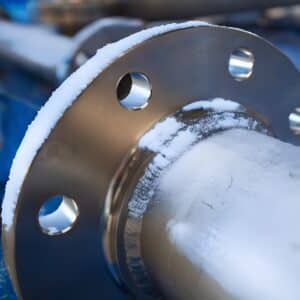
In some cases, a flange is welded directly onto the end of the pipe.
In the field, however, lining up an end weld and keeping everything square can be difficult. A practical workaround is to slightly open the inside diameter of the flange and slide the pipe into it. This allows the flange to sit in place without falling while it is being welded. That is where the term “slip-on” comes from.
Connection styles:
- Weld neck flange: welded onto the end of the pipe
- Slip-on flange: the pipe slips into the flange and is then welded
5. The main flange families people encounter
Plate flanges
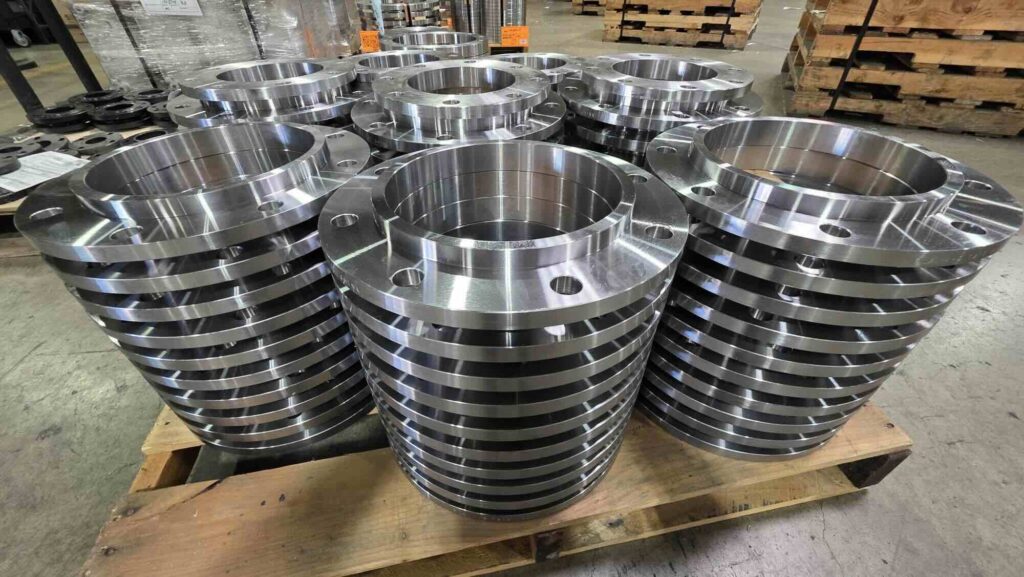
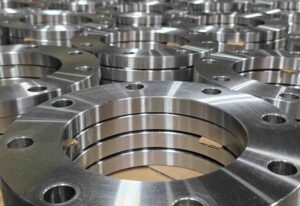
You will often hear flanges referred to as plate flanges. This does not necessarily mean they are made from plate material. It refers to the shape. They resemble a dinner plate: round and flat, with a hole in the center and bolt holes around the outside.
Examples include:
ANSI / ASME style flanges with a hub and sealing surface
ANSI / ASME style flanges have a hub on one side and a sealing surface on the other. They are often called raised face flanges, but that term is not always accurate. When a flange is raised face, the sealing surface is a ring raised approximately 1/16 inch above the face.
6. Raised face versus plate flanges
A raised face flange and a plate flange do not mate directly because of the raised sealing surface. When they need to connect, the raised face is removed so the joint becomes flat face to flat face. A gasket can then be installed, and the flanges can be bolted together.
7. Quick reference table
The Term | Description |
A lip you can grab and pull | |
Pipe slips into the flange, then you weld | |
Flange welds onto the end of the pipe | |
Flat disc with a center hole and bolt holes | |
Sealing ring raised about 1/16 inch | |
Sealing surface is flat |
8. Why standardization matters
For flanges to be used globally, they must be standardized. When someone specifies a class 150 flange, that pattern is the same regardless of where it is sourced. The flange design already implies the bolt size and layout. That is why bolt holes are typically about 1/8 inch larger than the bolt diameter.
Pressure ratings, bolts, and what gets standardized
Flanges play a role in pressure ratings, but they are not the only factor. Bolts matter as well, and engineers decide how the components work together.
A simple way to think about it is this: if a pipe system operates near 150 pounds of pressure, the flange connecting those pipes must meet or exceed that requirement. Flanges are designed with bolt sizing in mind, and the slightly oversized bolt holes make the intended bolt size obvious.
9. Where product support ends and engineering responsibility begins
A supplier can provide flanges, but they do not choose the bolt grade. That decision belongs to the engineer, who determines whether the application requires grade 3, grade 5, grade 8, etc., based on pressure and service conditions.
It is appropriate to explain what a flange is designed to handle. Final suitability, however, depends on the system design and operating conditions, which are evaluated by the engineer responsible for the application.
A wording mistake that creates real risk
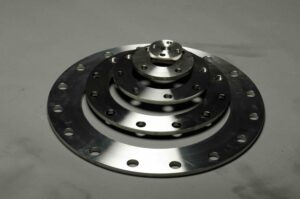
The phrase “150-pound flange” is commonly used, but it is misleading and risky. The correct term is class 150 flange. This refers to a standardized pattern and classification, not a literal pressure limit. Different classes can be mistakenly called 150-pound, even though they are not the same. When stacked, the bolt holes may line up and look identical from the top, but differences in thickness become clear from the side.
10. Why tolerances and material are not sales talking points
Tolerances exist because no two manufacturers produce parts exactly the same. Conditions vary. Temperature affects metal. Heat causes expansion, and cold causes contraction. A part must remain within tolerance across different environments. Something made in Alaska cannot arrive in Arizona significantly larger or smaller.
Material selection is also an engineering decision. It is not as simple as assuming higher cost means better performance. For example, 316L offers better corrosion resistance, while 304 can be stronger. Engineering requirements dictate the material choice.
API International flange experts
Our sales team at API International can answer any questions about your flange requirements and guide you toward the best solution for your system. You can also explore our full range of flanges in our online product catalog, or contact us for custom flange options designed to meet your project specifications. Get connected with a dedicated sales representative today, or call us at 503.692.3800.