
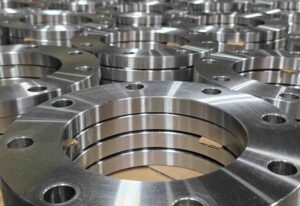
Oil and Gas Industry
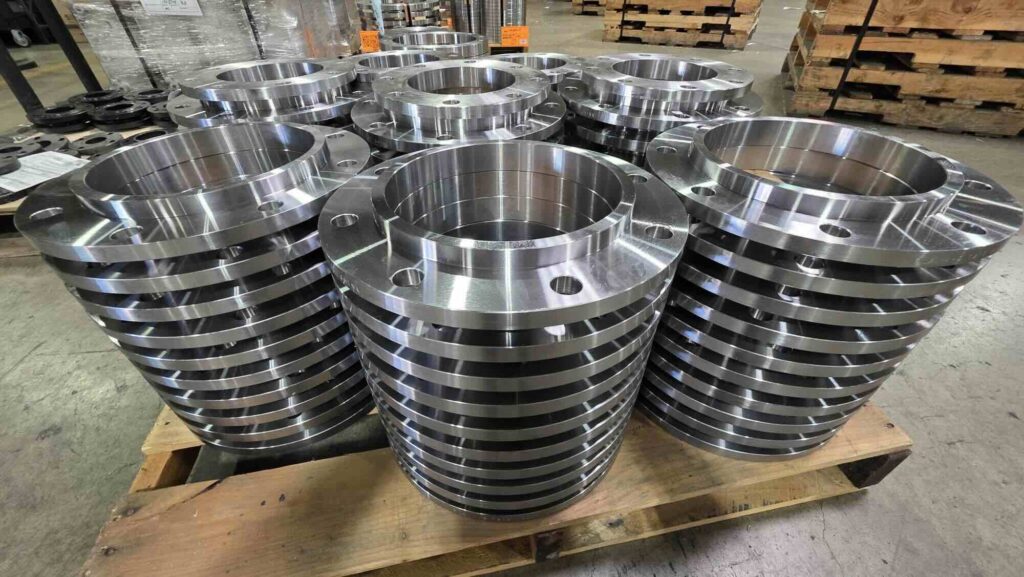
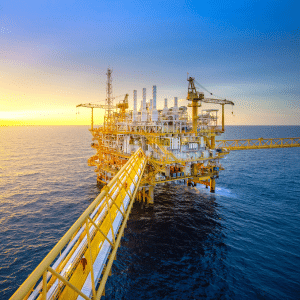
ANSI/ASME flanges are widely used across upstream, midstream, and downstream oil and gas operations. They provide standardized, high-integrity connections in pressure-critical piping systems. Upstream oil and gas operations rely on ANSI/ASME flanges in wellheads, flowlines, and manifolds to deliver fatigue-resistant connections under high pressure. Engineers most often specify weld neck flanges because their tapered hub design distributes stress more effectively in high-pressure and high-temperature applications.
Midstream and downstream facilities use ANSI/ASME flanges in transmission pipelines, pump and compressor skids, pressure vessels, heat exchangers, and refinery piping. Standardized pressure classes and dimensions support modular system design and simplify isolation and maintenance. These features reduce leakage risk and make these flanges the best choice for safe, efficient, and maintainable oil and gas infrastructure.
Chemical Processing Facilities
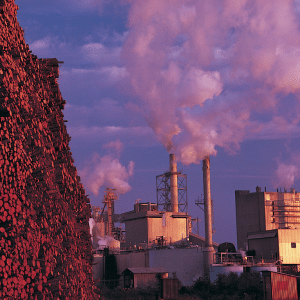
In the context of chemical processing, ANSI/ASME flanges connect piping systems that transport corrosive, reactive, or high-purity process media. Engineers typically install these flanges on reactor connections, heat exchangers, filtration units, and chemical transfer lines.
The standardized dimensions of ANSI/ASME flanges allow equipment to be integrated into a single system without dimensional conflict despite being supplied by different manufacturers. Material selection (such as stainless steel or nickel-based alloys) can be varied according to chemical compatibility requirements while maintaining compliance with the same flange standard. This combination of dimensional uniformity and material flexibility supports both operational safety and long-term maintainability.
Power Generation Systems
Power generation facilities, which include fossil-fuel, nuclear, and combined-cycle plants, use ANSI/ASME flanges in steam, condensate, and cooling water systems. These applications often involve high temperatures ranging from approximately 400°F to over 1,050°F (200°C to 565°C) and pressures commonly between 600 psi and 3,500 psi, particularly in boiler outlet piping, main steam lines, and reheater circuits.
ANSI/ASME flanges in power generation serve the dual purpose of providing pressure containment and allowing controlled disassembly during scheduled outages. High-pressure classes defined by ASME B16.5 and ASME B16.47 standards help engineers select flanges suitable for high-heated steam service. Standardized bolting patterns and facing dimensions support consistent assembly, inspection, and maintenance practices across plant systems.

Water and Wastewater Infrastructure
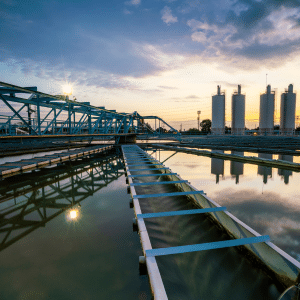
Although waterworks systems often rely on AWWA standards for large-diameter piping, water and wastewater facilities commonly specify ANSI/ASME flanges at equipment interfaces and auxiliary process lines. Common installation points include pump suction and discharge connections, chemical dosing skids, filtration systems, and treatment process piping.
In these applications, ANSI/ASME flanges are able to isolate pumps, valves, and equipment for service or replacement without cutting or reworking pipe. ASME standard bolt patterns and facing dimensions allow replacement components to be sourced quickly from multiple suppliers. ANSI/ASME flanges become a practical choice for municipal infrastructure due to their reliability, serviceability, and downtime control.
Manufacturing and Industrial Facilities
General manufacturing facilities use ANSI/ASME flanges in a wide range of utility and process piping systems, which include compressed air, hydraulic fluids, cooling water, and non-hazardous process media. These systems often evolve over time as production requirements change.
ANSI/ASME flanges support adaptability across different environments by enabling modular piping layouts and straightforward system modifications during installation and upgrades. Flanged joints allow sections of piping to be removed or reconfigured with minimal disruption, which makes them well suited for environments where flexibility and maintainability are prioritized.
HVAC and Mechanical Systems
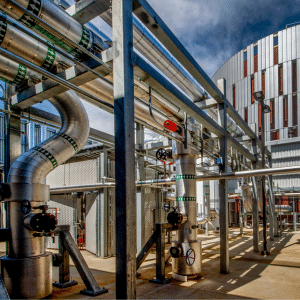
HVAC and mechanical piping systems commonly use ANSI/ASME flanges in chilled water, hot water, and steam distribution networks which serve commercial and institutional buildings.
In these systems, facilities install flanges at pumps, chillers, boilers, and heat exchangers. They allow equipment to be isolated, removed, or replaced during routine service and system upgrades. ANSI/ASME flanges provide consistent fit-up and sealing performance, which makes it easier to source replacement components and maintain alignment over long operating cycles. While lower pressure classes are often sufficient for HVAC applications, using ANSI/ASME standard flanges supports reliable installation, maintenance planning, and long-term system operation.
ANSI/ASME Flange Application Overview
reliability
| Industry Sector | Common System Locations | Functional Purpose | Primary Flange Type |
|---|---|---|---|
| Oil & Gas | Pipelines, valve stations, compressors | High-pressure containment and serviceability | Weld Neck |
| Chemical Processing | Reactors, exchangers, transfer lines | Material compatibility and equipment integration | Slip-on/Lap Joint |
| Power Generation | Steam and condensate systems | High-temperature and pressure performance | Weld Neck |
| Water & Wastewater | Pumps, treatment equipment | Maintenance access and standardization | Slip-on/Lap Joint |
| Manufacturing | Utility and process piping | System flexibility and modularity | Threaded/Slip-on |
| HVAC Systems | Chilled water and steam loops | Equipment isolation and long-term | Slip-on |