
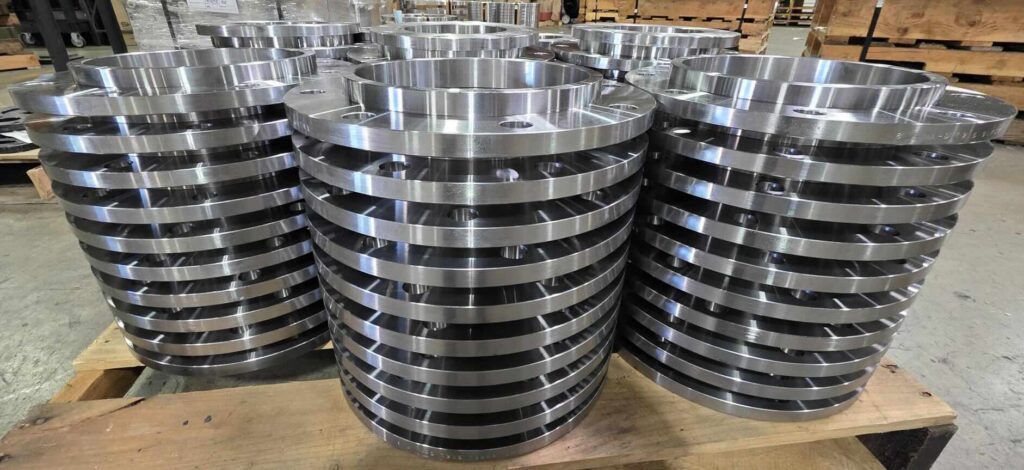

If you have worked around flanges long enough, you have seen it. Two different suppliers, two flanges made to the same specification, with the same dimensions, tolerances, material, and standard, and still do not look equal when they arrive. One shows up, and you feel confident it can be installed in piping systems. The other flange shows up, and your first reaction is “What happened to it?”
That gap is what this is about. In the real world, flange quality is not only what a caliper says. Quality is also what the customer sees, feels, and can trust, especially when they are handling a hundred other parts from different suppliers. The difference is rarely just emotional. Some crews have to spend an extra 10 to 15 minutes per flange sorting, rechecking, or even cleaning a batch that looks questionable, compared to zero time spent when every flange arrives clean, organized, and ready for use.
Our goal is simple: the customer should not open the box and feel anxiety.
“It Is What It Is” Is Not a Quality Standard
Here’s an example we hear from new customers way too often: they place an order of ASME B16.5 flanges from a supplier that isn’t API International. The flanges looked great based on their website. But upon arrival, the flanges have noticeable scratches, chipped paint, and a rough finish. The customer requests a new shipment from a different warehouse. When the replacement order arrives from a different warehouse, it’s the same story: same scratches, chipped paint, and rough-looking finish.
And the response from the supplier? “That is all the stock we have. It is what it is. You want it or not, it does the job.”
Here is the part that matters. Those flanges can still be within tolerances. The scratches can be superficial. They might not even touch the serration in a way that causes leaks. On paper, they meet spec. But in practice, the consequences are real. If your supplier is left unchecked, you can receive a shipment of flanges that technically meet specifications but arrive with visible scratches and paint chips. Causing you or your customer to reject the order on arrival, pushing their project back by 36 hours, and resulting in lost labor and equipment costs exceeding $7,000. What looked like a minor cosmetic issue on a spec sheet created a major setback in the field.
Customer expectations matter. When you put that flange next to one that is nice and clean, handled with care, and something you feel like you can eat your lunch off of, the contrast is immediate. Both technically meet the same specification, but only one of them communicates care.
Two Flanges Can Meet the Same Spec and Still Feel Totally Different
This is where the real question shows up. If two flanges are made to the same specification, how do you put one of them ahead of the other one?
In many cases, two manufacturers can produce the same flange, and both can pass quality control. Same geometry. Same bolt circle. Same drilling. Same thickness. Same tolerances. If you pull stock off the shelf and measure it, the deviation is hardly noticeable. Practically identical flanges. So what separates them when the measurements look the same? Often, it is the things the paperwork does not capture: handling discipline, packaging and protection, finish consistency across a batch, and the internal QC culture that decides what is acceptable to stock and ship.
That is not a marketing trick. It is practical. The look becomes a signal of how the part was handled, how it was stored, and how the supplier carries themselves as a standard.
| What Specifications Cover | What Paperwork Doesn’t Cover |
| Dimensions and tolerances | Surface condition and handling marks |
| Material grade and standard | Packaging and protection in transit |
| Facing and drilling accuracy | Finish consistency across the shipment |
| Compliance on paper | Confidence when opening the box |
| Fit and seal potential | Trust in the supplier’s process |
Meeting the spec keeps you in the game. But what truly sets a supplier apart is the second column. It is what earns trust and repeat business. It’s what is not written on the drawing, but it is obvious the moment someone opens the box and feels ready to head to the job site, no hesitation or re-checks needed. Giving this hidden dimension a name helps buyers and teams talk about what really matters.
Flange Appearance Matters Depending on the Application
Every flange buyer has different priorities; a good sales team, like the team at API International, will recognize their priorities. For example, the emergency maintenance buyer is focused on uptime, speed, and getting back online. For this persona, flange appearance is a distant concern. As long as the gasket surface is sound and the dimensions check out, the part is going to get sandblasted or painted anyway, or installed deep inside a system where no one will ever see it again.
Picture a ship coming into port with a burst steam line. The ship’s team is working in saltwater, up against the clock, and every hour counts. The emergency maintenance buyer needs the right flange, fast. In this scenario, nobody is worried about scratches or finish. The urgency outweighs aesthetics- they install the flange, oil it to prevent rusting, and get back to sea.
Now compare that with the OEM aesthetics buyer. This persona is building pumps, assemblies, or packaged systems that ship out to their own customers. The flange is often visible and serves as a representation of their brand. Here, a scratched or poorly finished flange is not just a cosmetic issue, but a strike against the final product. In this world, appearance directly affects perceived quality and value.
Both customers can be buying flanges to spec, but the expectations are not the same. At API International, we only provide the highest-quality flanges, so we know there won’t be any issues down the line.
The Dirty Car Problem and Why First Impressions Change Trust
A simple example makes this obvious. When you are selling a new car, the customer won’t buy it if it has scratches.
That is why they wrap it up and deliver it clean.
That is why they wrap it up and deliver it clean.
A nearly new car can be mechanically fine, but if you go to test-drive it and it shows up with dog hair inside and mud on the side, it changes how the buyer feels immediately. Most people cannot picture paying full price for it. They cannot see past it.
The same thing happens when a customer opens a box of flanges, and the condition appears neglected. Even if the product might work in the field, confidence drops immediately. It is not only about cleanliness. It is what it signals. The customer starts asking themselves what else might be off. The hidden cost is real: when a flange looks questionable, engineers and technicians may spend extra hours re-inspecting or double-checking parts that should have been ready to install. That mental load leads to lost productivity, delayed schedules, and drained resources, even if no technical issue is found.
This is where quality becomes practical in a way that people remember. Buyers want peace of mind. They want to feel like they do not need to verify everything just to be comfortable using it.
Customers Are Not Buying Clean Flanges, They Are Buying the Standard Behind Them
People are not buying quality flanges to admire them. They are buying what the quality represents.
In many industries, the end result can look the same if it passes inspection. But not every company carries itself the same way. A strong quality culture shows up in the details.
Electrical work is a good example. Nobody sees the wires in the wall. You can do wiring two different ways and still pass inspection. But some crews wire like it is an art piece: clean lines, organized runs, and everything intentional. People are not buying clean wires. They are buying the fact that the person installing those wires cannot tolerate sloppy work.
That mindset is the real product, and flanges are similar. When a company refuses to stock and ship flanges that look unacceptable, it is not vanity. It is discipline. It is process control. It is pride of workmanship. It is the internal standard that prevents bigger problems and develops trust over time. Which standard would you rather bet your reputation on: the one that settles for “it is what it is,” or the one that refuses to let anything questionable out the door?
And it matters because buyers are trying to reduce mental load. They have a million things to order. The poor people building pumps are dealing with a ton of parts from various suppliers. The last thing that should be on their mind is whether the parts will fail or whether they even need to think about it.
Meets Spec Is Necessary, but It Is Not the Whole Promise
Meeting the specification matters. It is required. But for most buyers, meets spec is the baseline.
The real question is whether the supplier makes their job easier or harder.
What customers want is peace of mind. They want to know they can call someone, talk through the order, bounce information off someone, and trust that the supplier is more than an order taker. The reality is that software can replace order taking. It can calculate, quote, and show stock levels based on a login. No software can replace the human standard. The discipline. The ability to care. The ability to ship something that makes the customer feel confident instead of uneasy.
Customers do not want to think about flanges. They want to build, install, ship, and move on. A flange that arrives clean and consistent communicates a powerful message: you can relax. This part won’t be a problem. This is what makes API stand out from the crowd.
Bottom Line
The API International standard: zero trust failures on arrival. A flange can meet spec and still create friction. Scratches, chipped paint, sloppy handling, and inconsistent finish are not always functional failures. But they often become trust failures, and trust is what drives repeat business. At API, we make sure every flange we ship arrives in a condition that meets our standards. If it doesn’t, we will make it right. That is our commitment to you and your reputation.
Specs matter. Tolerances matter. Standards matter. But so does the customer experience, from the moment they open the box to the moment they bolt it up. Because in the real world, “it is what it is” is not a standard. Customers can feel the difference.
What This Means at API
At API, we believe our job is bigger than shipping a flange that meets spec. We want the experience to feel clean, predictable, and professional from the moment you open the box. If you have a tricky flange issue or a recent order that didn’t meet your expectations, give us a call and tell us about your toughest flange headache. We’ll get you a same-day solution – no forms, no waiting, just people that care. Let us take something off your list so your customers can order with confidence.