

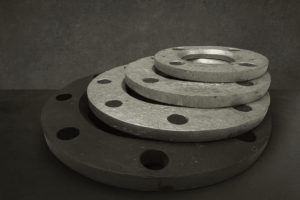
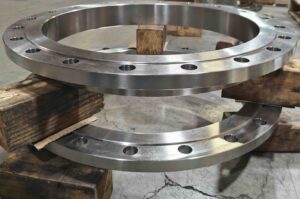
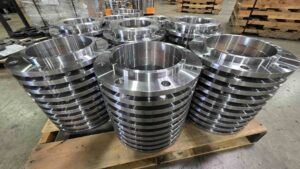
DIN and ANSI / ASME flanges are governed by two completely different standards systems which are used in piping, mechanical, and industrial engineering. While both of them define flange dimensions, pressure ratings, materials, and tolerances, they are still built on different measurement systems, regional practices, and design methodologies. DIN flanges are metric-based and primarily used in Europe and international markets. ANSI / ASME flanges are imperial-based and primarily used in the United States and North America. Because of these fundamental differences, DIN and ANSI flanges are not dimensionally compatible and should not be considered interchangeable.
What Is DIN?
DIN — Deutsches Institut für Normung
DIN stands for Deutsches Institut für Normung, meaning the German Institute for Standardization. DIN develops technical standards and covers dimensional accuracy, material properties, safety requirements, and testing methods across manufacturing, construction, mechanical engineering, piping, and industrial systems.
Many DIN piping standards have been harmonized into European Norm (EN) standards governed by CEN (European Committee for Standardization). In flange applications, the most common standard is: EN 1092-1 — Circular steel flanges.
DIN / EN standards are primarily used in:
- Germany
- European Union member states
- International export markets
- Metric-based engineering systems
DIN dimensions are expressed in millimeters, and pressure ratings are defined using the PN system.
What Is ANSI / ASME?
ANSI — American National Standards Institute / ASME — American Society of Mechanical Engineers
In piping and flanges, the actual dimensional standards are published by ASME / ANSI. These flanges are manufactured to standardized designs to ensure uniformity in dimensions, tolerances, pressure-temperature ratings, and material selection across industrial systems. The most widely used flange standard is: ANSI / ASME B16.5 — Pipe Flanges and Flanged Fittings. In industry, ANSI / ASME B16.5 flanges are commonly referred to as “ANSI flanges,” although ASME is the publishing body.
ANSI / ASME standards are primarily used in:
- United States
- Canada
- North America
- Imperial-based engineering systems
ANSI / ASME flange dimensions are expressed in inches and use pressure Class ratings rather than PN ratings.
DIN and ANSI / ASME Dimensional Differences
This table summarizes the core structural differences between DIN / EN and ANSI / ASME flange systems, including standards governance, measurement units, pressure classification, and dimensional conventions.
| Category | DIN / EN Flanges | ANSI / ASME Flanges |
|---|---|---|
| Primary Region | Europe, International | United States, North America |
| Governing Body | DIN / CEN (EN) | ANSI / ASME |
| Main Flange Standard | EN 1092-1 | ASME B16.5 |
| Measurement Units | Millimeters (mm) | Inches (in) |
| Pressure System | PN (Nominal Pressure) | Class (Pressure Class) |
| Typical Materials | EN steels | ASTM steels (A105, A182, etc.) |
| Bolt Dimensions | Metric bolts | Inch bolts |
| Facing Dimensions | Metric profiles | Inch profiles |
Pressure Rating Systems: PN vs Class
DIN and ANSI / ASME use fundamentally different pressure rating systems, with PN representing nominal pressure at a reference temperature and ANSI / ASME Class ratings varying based on material group and operating temperature. Direct one-to-one pressure conversion is not possible.
DIN PN Rating System
PN stands for Nominal Pressure, representing the allowable working pressure at a reference temperature.
Common PN ratings:
| PN Rating | Nominal Pressure |
|---|---|
| PN6 | 6 bar |
| PN10 | 10 bar |
| PN16 | 16 bar |
| PN25 | 25 bar |
| PN40 | 40 bar |
* As temperature increases, allowable working pressure decreases.
ANSI / ASME Class Rating System
ANSI / ASME uses pressure classes that vary based on material group and temperature.
Common Class ratings:
| ANSI Class | Typical Pressure Range* |
|---|---|
| Class 150 | ~285 psi |
| Class 300 | ~740 psi |
| Class 600 | ~1480 psi |
| Class 900 | ~2220 psi |
| Class 1500 | ~3705 psi |
| Class 2500 | ~6170 psi |
* Actual ratings depend on material and temperature tables in ASME B16.5.
Why PN and Class Are Not Equivalent
Although people often attempt to match PN16 with Class 150 or PN40 with Class 300, there is no true equivalency between the systems.
Key differences include:
- Bolt circle diameter differences
- Bolt hole quantity and size differences
- Flange thickness differences
- Gasket seating surface differences
- Tolerance methodology differences
! Even small dimensional mismatches can prevent proper bolt alignment, gasket compression, and sealing integrity.
Dimensional Comparison Example: DN100 vs NPS 4
DN and NPS nominal sizes do not indicate dimensional compatibility. The example below compares a DN100 PN16 flange with an ANSI / ASME Class 150 NPS 4 flange to illustrate these dimensional differences.
| Parameter | DIN EN 1092-1 PN16 (DN100) | ANSI / ASME B16.5 Class 150 (NPS 4) |
|---|---|---|
| Nominal Size | DN100 | NPS 4 |
| Outside Diameter | 220 mm (8.66 in) | 228.6 mm (9.00 in) |
| Bolt Circle Diameter | 180 mm | 190.5 mm |
| Number of Bolts | 8 | 8 |
| Bolt Size | M16 | 5/8″ |
| Flange Thickness | ~20 mm | ~16 mm |
| Facing Type | Raised Face (EN) | Raised Face (ASME) |
Bolt Pattern Differences
Bolt circle geometry and fastener standards must align precisely for a flange joint to clamp evenly and seal correctly. The table below presents a technical comparison of bolt pattern characteristics.
| Feature | DIN / EN | ANSI / ASME |
|---|---|---|
| Bolt Units | Metric | Imperial |
| Bolt Diameter | M12, M16, M20, etc. | 1/2″, 5/8″, 3/4″, etc. |
| Hole Spacing | Metric pitch circle | Inch pitch circle |
| Tolerances | EN tolerances | ASME tolerances |
| Stud Lengths | Metric threads | UNC / UN threads |
! Mixing metric and imperial bolting creates fitment and torque control issues.
Are DIN and ANSI / ASME Flanges Interchangeable?
No. DIN and ANSI / ASME flanges are not interchangeable.
Attempting to mate DIN and ANSI / ASME flanges can result in:
- Misaligned bolt holes
- Improper gasket seating
- Uneven bolt loading
- Leakage under pressure or temperature cycling
- Code compliance violations
- Long-term reliability issues
! If system transitions are required, engineered adapter flanges or transition spools must be used.
API Can Help you with Selecting DIN or ANSI / ASME Flanges
Working with experienced flange manufacturers and distributors ensures that dimensional standards, pressure ratings, materials, and gasket interfaces are properly aligned for long-term performance and safety. Our sales team at API International can answer any questions about your flange requirements and guide you toward the best solution for your system. You can also explore our full range of DIN and ANSI / ASME flanges in our online product catalog, or contact us for custom flange options designed to meet your project specifications. Get connected with a dedicated sales representative today, or call us at 503.692.3800