Call us today:

DIN Flange Dimensions and Specifications

Deutsches Institut für Normung (DIN) is one of the standards organizations that complies with European and International standards. DIN sets industry guidelines for quality assurance and safety, including flange materials requirements and pressure and temperature rating. DIN flanges are widely used in metric piping systems across Europe and in international industrial projects. While the term “DIN flange” is still commonly used in the industry, dimensional requirements are typically governed by DIN EN 1092-1. This article explains how DIN flange dimensions are defined, how pressure classes affect geometry, and how engineers should interpret EN 1092-1 dimensional tables when specifying or replacing flanges.

1. What DIN EN 1092-1 Covers

DIN EN 1092-1 defines the dimensional and drilling requirements for circular steel flanges which are used with pipes, valves, fittings, and other piping systems. Although originally derived from German DIN specifications, today, EN 1092-1 is widely referenced globally across manufacturers. This standard defines the following aspects:
  • Nominal sizes (DN)
  • Pressure ratings (PN)
  • Flange facing types
  • Dimensional tolerances
  • Bolt hole patterns and counts
* By standardizing these elements, EN 1092-1 ensures that flanges manufactured by different suppliers remain dimensionally interchangeable when matched by DN and PN class.

2. Nominal Size (DN) and Dimensional Meaning

DIN flanges are designated by DN (Diamètre Nominal), which represents the nominal pipe size in millimeters. DN is more of a reference size rather than an exact measurement of the inside diameter of the pipe, so it should not be confused with the actual bore or outside diameter of the flange.

Common DN sizes include:

  • DN25, DN40, DN50
  • DN80, DN100, DN150
  • DN200 through DN1000+
Example DN Sizes and Typical Applications
DN Size Approx. Pipe Size Typical Applications
DN25 ~1 in Instrument lines, small utility piping, compressed air, control systems
DN50 ~2 in Process skids, water distribution branches, HVAC piping
DN100 ~4 in General process piping, pump suction and discharge, building services
DN150 ~6 in Main headers, fire protection systems, chilled water distribution
DN300 ~12 in Industrial process mains, plant utility distribution
DN600+ 24 in and larger Transmission lines, cooling water systems, infrastructure pipelines
For example, a DN50 flange is designed to mate with pipe systems nominally identified as DN50, but the flange’s internal bore, outside diameter, and bolt pattern are defined precisely by EN 1092-1 tables. This distinction is critical when verifying fitment across mixed piping systems or between different manufacturers.

3. Pressure Ratings and Their Impact on Dimensions

DIN EN 1092-1 uses PN (Pressure Nominal) classes to define allowable working pressure. Common pressure classes include PN10, PN16, and PN25. Unlike nominal size, the PN class directly affects the structural dimensions of the flange, which include flange thickness, bolt size, and bolt count.

As PN rating increases:

  • Flange thickness increases
  • Bolt diameter most likely increases
  • Bolt count may increase
  • Load-bearing capacity improves
In a typical case a DN150 PN10 flange and a DN150 PN25 flange share the same nominal size but they differ significantly in thickness and drilling requirements. Higher PN ratings require increased flange thickness and stronger bolting to maintain sealing integrity. These differences are not optional, because they are fixed by the standard and must be respected to maintain system integrity.

4. Flange Types Under DIN EN 1092-1

DIN EN 1092-1 defines several standardized flange forms used in European and international piping systems, including weld neck flanges, blind flanges, threaded flanges, flat plate slip-on flanges, and lapped flanges. Each flange form is identified by a type designation within the standard.
Typical Applications of DIN EN 1092-1 by Flange Type
Flange TypeDIN EN TypeTypical Use
Flat (Slip-On)Type 01General piping connections where ease of installation and alignment are important
LappedType 02 / Type 04Systems requiring alignment flexibility or frequent disassembly
BlindType 05Terminating or isolating piping systems for maintenance, testing, or future expansion
Weld NeckType 11Higher-pressure or cyclic service where stress distribution and fatigue resistance are critical
ThreadedType 12Low-pressure piping systems where welding is not practical or permitted

Type 01 (Slip-On) Flanges – API International Manufacturing Scope

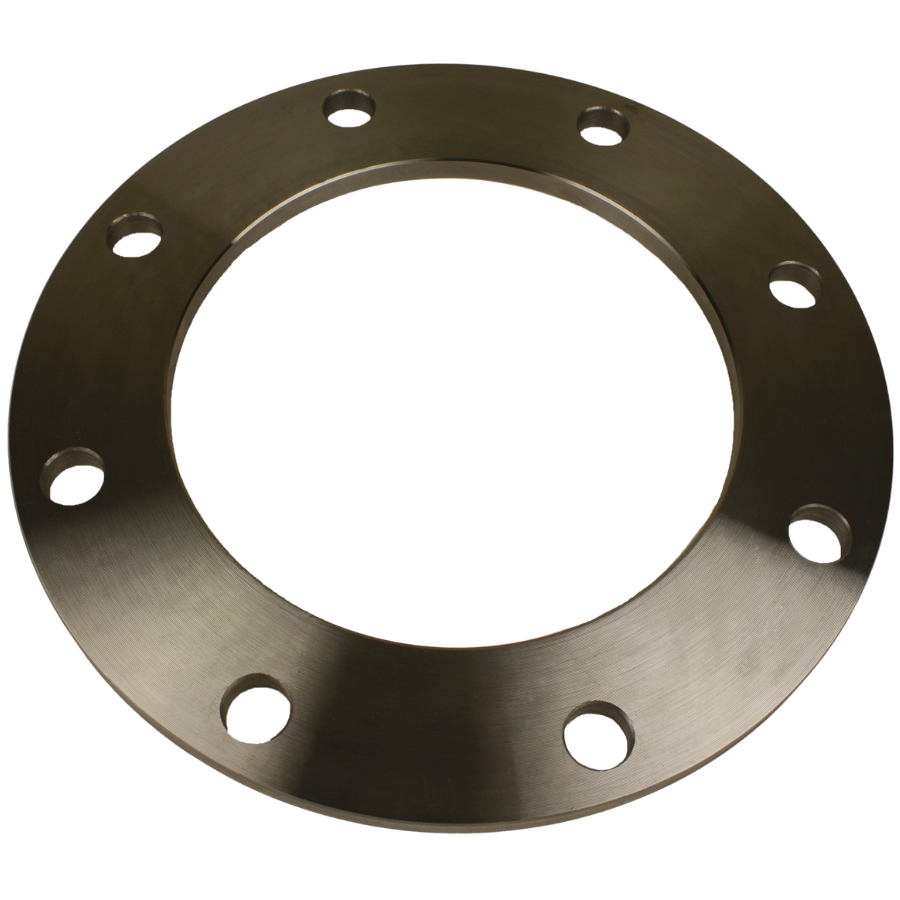
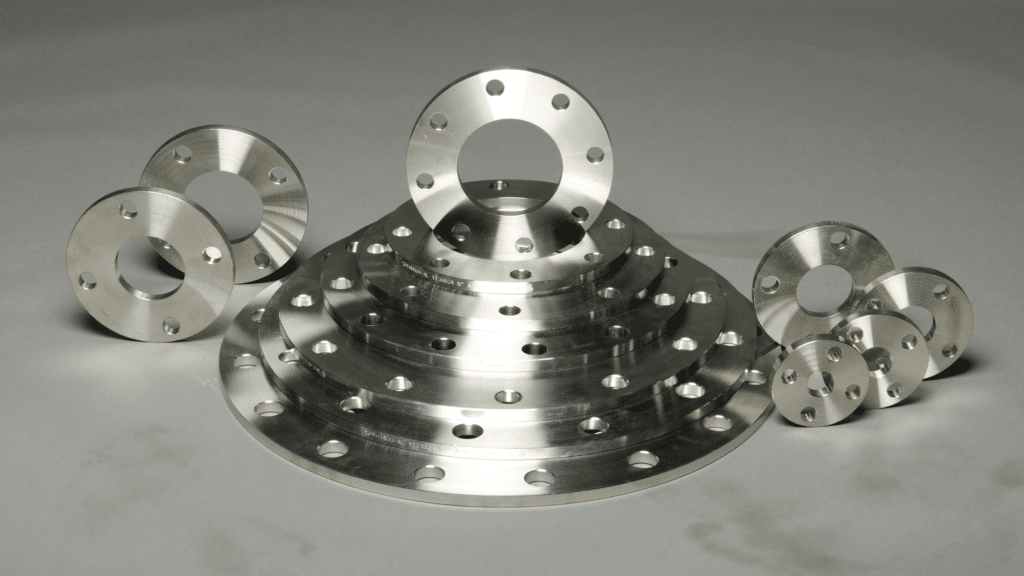
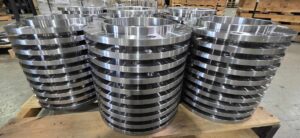
At API International, our DIN flange production is focused primarily on Type 01 plate (slip-on) flanges that are manufactured to the DIN EN 1092-1 specification. These flanges are widely used in low-to-moderate pressure piping systems because of their installation simplicity, dimensional consistency, and broad compatibility with metric piping networks.

Type 01 flanges are designed to simply slip over the pipe after which they need to be welded in place. This approach allows efficient alignment during the installation process, and, at the same time, it maintains consistent bolt patterns and sealing geometry. Dimensional tolerances, bolt circle placement, flange thickness, and facing geometry are governed directly by EN 1092-1 tables.

DIN flange

5. Key Dimensional Elements Defined by the Standard

Every DIN EN 1092-1 flange is defined by a consistent dimensional structure.

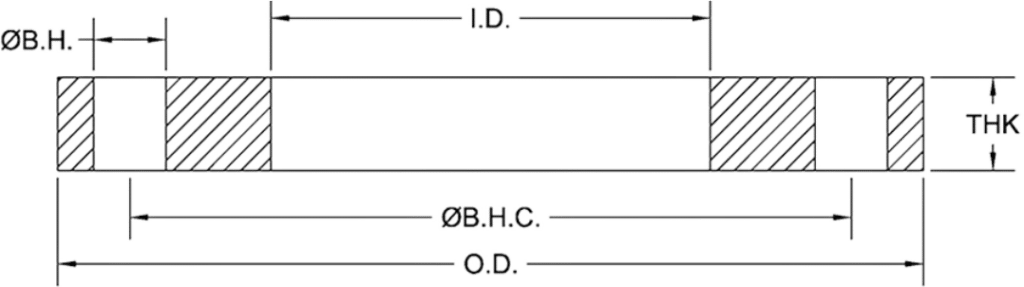
The most critical measurements include:

  • Outside Diameter (OD)
  • Inside Diameter (ID)
  • Flange Thickness (THK)
  • Bolt Hole Circle Diameter (BHC / PCD)
  • Bolt Hole Diameter
  • Number of Bolt Holes
Below is an example excerpt from API International’s DIN EN 1092-1 dimensional data for steel slip-on flanges.
Nominal Size (DN) Pressure Class Outside Diameter (mm) Bolt Circle (mm) Flange Thickness (mm)
DN50 PN10 165 125 20
DN50 PN16 165 125 22
DN50 PN25 165 125 26
DN150 PN10 285 240 24
DN150 PN16 285 240 26
DN150 PN25 300 250 30
* Exact values and full size ranges are defined in the EN 1092-1 dimensional tables supplied by API International.

6. Bolt Patterns and Sealing Considerations

Bolt pattern geometry established by DIN EN 1092-1 ensures consistent load distribution, dimensional compatibility, and predictable sealing performance across flange sizes and pressure classes.

Under the standard, each DN and PN combination defines:

  • Exact bolt quantities 
  • Bolt hole diameters 
  • Bolt circle diameters (PCD) 

Flange Facing Configurations

Facing types define the geometry of the sealing surface of a flange and directly influence gasket selection, sealing behavior, and allowable surface loading. Similar to ANSI / ASME flanges, EN 1092-1 steel and stainless steel flanges are manufactured with standardized facing configurations identified by European form designations.

Facing types commonly include:

These facing types ensure gasket compatibility and consistent sealing performance across installations.

7. Materials and Manufacturing

In practice, EN 1092-1 flanges are commonly manufactured from carbon steel or stainless steel, depending on corrosion exposure, mechanical strength requirements, and fabrication constraints.
Typical Flange Materials Used Under EN 1092-1
Material Category Common Grades Typical Application
Carbon Steel A105, A350 General pressure piping, structural strength, standard industrial service
Stainless Steel 304, 304L, 316, 316L Corrosion resistance, chemical processing, food and sanitary systems
* For complete material definitions and requirements, refer to the official DIN EN 1092-1 standard document from the Deutsches Institut für Normung (DIN).

8. Summary

DIN EN 1092-1 provides a unified framework for flange dimensions, pressure classes, facing types, and material compatibility. This standard ensures consistent performance and interchangeability across metric piping systems. At API International, Inc., we stock PN-rated steel and stainless steel slip-on flanges manufactured to the Deutsches Institut für Normung (DIN) EN 1092-1 specification. Choose from a wide range of slip-on, ring-style flanges sized according to DIN metric standards available in DIN-PN10, DIN-PN16, and DIN-PN25. If our standard flanges don’t meet your specific requirements, our Custom Machining Shop provides precision manufacturing of custom parts as well as modifications to stock items.