
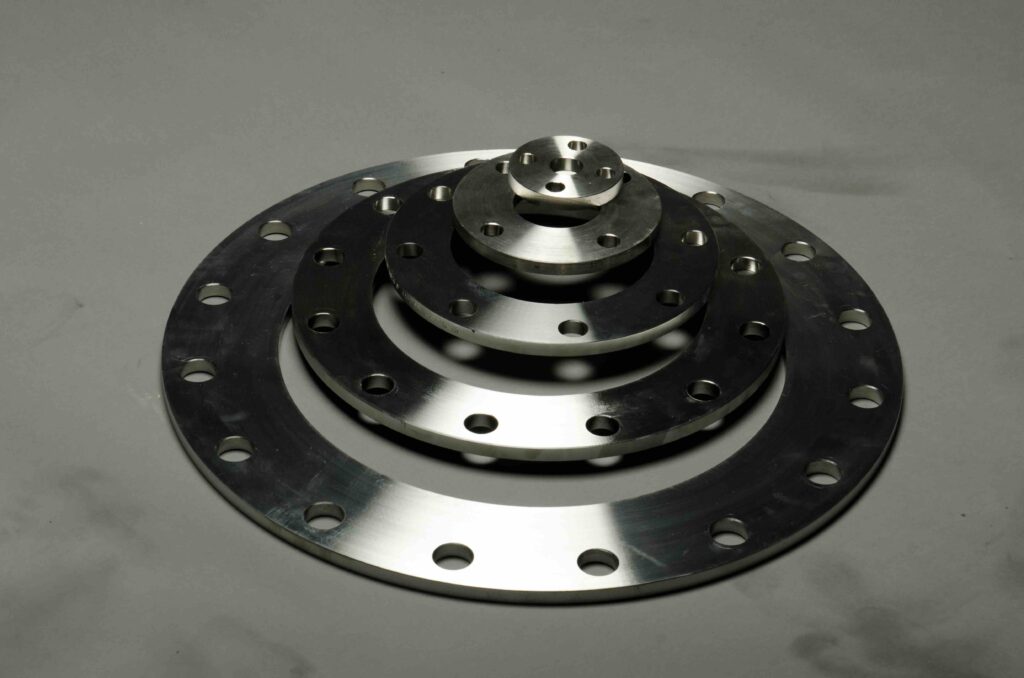

Main Reasons to Choose Plate Flanges:
1. Cost-Effectiveness for the Right Scope
Where the savings are most pronounced:
| Flange Type | Plate Manufacture | Forged Manufacture |
|---|---|---|
| Blind Flange | Very efficient | Higher cost, longer lead |
| Slip-On Ring Flange | Efficient | Moderate cost |
| Weld Neck Flange | Not applicable | Standard route |
| Long Weld Neck | Not applicable | Standard route |
2. Direct Alignment with Waterworks Practice
3. A Simple, Proven Connection Method
The installation sequence is straightforward:
- Slide the flange over the pipe end
- Position to the correct standoff dimension
- Apply fillet welds to both the face side and back side of the flange
- Machine or verify the gasket face finish
- Bolt up with appropriate gasket and fasteners
4. Custom Transitions Are Practical to Fabricate
Situations where this advantage stands out include:
- Mismatched bore sizes
- One side requiring a standard bolt pattern
- Retrofit and modification work
- Special equipment or utility tie-ins
5. Material Selection Supports Corrosion Control
Plate flanges are routinely produced in:
| Material | Common Specification | Typical Application |
|---|---|---|
| Carbon Steel (A36) | ASTM A36 | Standard water service with protective coating |
| Stainless Steel (304 / 316) | ASTM A240 | Corrosive water chemistry, reclaimed water, coastal |
| Duplex Stainless (2205) | ASTM A240 | High-chloride or high-pressure aggressive service |
6. The Right Choice When Service Conditions Allow
This advantage is strongest when:
- The service is low to moderate rather than extreme
- The governing specification allows plate-style fabrication
- The system does not justify a heavier forged flange
- The goal is fit-for-service performance without over-specifying
Summary Table: Why Choose Plate Flanges?
| Reason | Why It Matters | Best Fit |
|---|---|---|
| Cost-effective for the right scope | Helps avoid over-specifying the connection | Waterworks, utility, and selected industrial service |
| Direct alignment with waterworks practice | Matches common service expectations in municipal and treatment systems | AWWA-style piping and water infrastructure |
| Simple, proven connection method | Supports practical assembly, maintenance, and isolation | Slip-on and blind flange applications |
| Custom transitions are practical | Makes bore and geometry changes easier in special situations | Retrofits, tie-ins, and specialty connections |
| Material selection supports corrosion control | Allows better matching to environment and fluid conditions | Carbon steel and stainless service |
| Best choice when loads/service allow | Provides practical performance without unnecessary complexity | Low-to-moderate service conditions |
When Plate Flanges May Not Be the Best Choice
It is also worth being clear about what this post does not mean. Choosing a plate flange is not automatically the right move just because it is economical or familiar. In higher-pressure, higher-temperature, high-load, or more code-sensitive service, the project may call for a forged flange or another connection method altogether. That is why the real question is not simply, “Are plate flanges good?” The better question is, “Do plate flanges fit the actual design basis of this system?” If the answer is yes, they are often an excellent choice. If the answer is no, another flange style may be more appropriate.
Conclusion
So, why choose plate flanges? Plate flanges have a clearly defined and well-supported role in industrial and waterworks piping. They’re cost-effective for ring-type and blind geometries, directly aligned with AWWA waterworks standards, simple to install and maintain, and adaptable to custom transition requirements. They are available in corrosion-resistant alloys and are suitable for most low to moderate-pressure water service applications.
The key is not choosing plate flanges by habit. Rather, choose them when the project scope, service conditions, and governing standard all support them. Our sales team at API International specializes in navigating complex flange requirements to ensure your flanges meet your design specifications. Explore our comprehensive range of plate flanges in our online product catalog, or contact us for custom options tailored to your unique project needs. Get connected with a dedicated sales representative today or call us at 503.692.3800.