

1. Easy Assembly and Disassembly
Table 1: Assembly Comparison – Flanged vs Welded Connections
| Factor | Flanged Connection | Welded Connection |
|---|---|---|
| Installation Time | Installed by bolting, usually faster to assemble | Requires welding and cooling, which extends installation time |
| Maintenance | Can be unbolted for inspection, resealing, or replacement | Requires cutting and re-welding, making maintenance more time-consuming |
| Cost Over Lifecycle | Lower overall cost due to easier serviceability | Higher overall cost due to rework and longer downtime |
2. Standardization and Interchangeability
The key aspects of standardization of flanges:
Ensures consistent performance.
Reduces risk of mismatched parts.
Supports global supply chains.
3. Reliable Sealing and Leak Prevention
Factors That Affect Leak Prevention in Flanged Joints
| Factor | Role in Leak Prevention | Notes / Guidance |
|---|---|---|
| Gasket Selection | Provides the primary sealing surface between flange faces. | Standards like ANSI/ASME/AWWA define materials and tolerances. |
| Bolt Load & Torque | Ensures uniform compression of the gasket. | ASME PCC-1 standard provides torque tightening procedures to achieve correct preload. |
| Flange Surface Finish | Impacts how well the gasket seats. | A rougher, serrated finish provides the necessary friction to prevent the soft material (like rubber, compressed fiber, PTFE, or graphite sheet) from being squeezed/blown-out under bolt load and internal pressure. The texture provides a “bite” into the gasket material. A smoother finish is required for hard metallic/semi-metallic gaskets because the material (metal rings or spiral windings) is less conformable. A rough surface would create too many leak paths that the rigid gasket material cannot completely fill, requiring a higher, potentially damaging bolt load. |
| Operating Pressure & Temperature | Determines gasket material suitability. | For high-pressure steam, metallic gaskets (such as spiral wound or RTJs) are required for their superior temperature and pressure stability. For lower-pressure, ambient temperature services (like standard water distribution), elastomeric gaskets (such as EPDM or SBR) are commonly used due to their conformability and cost-effectiveness. |
| Assembly Practices | Proper cross-pattern bolt tightening prevents uneven stress. | PCC-1 recommends controlled tightening sequences and re-torque after initial load cycles. |
4. Support for High Pressure and Temperature Applications
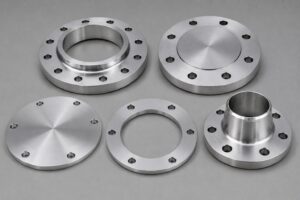
Different flange types are used depending on application requirements:
- Weld Neck Flanges – Designed with a long tapered hub that transfers stress to the pipe, this type is ideal for high-pressure and high-temperature pipelines.
- Blind Flanges – Used to seal or isolate sections of a piping system, which allows pressure testing or system modification without fluid leakage.
- Slip-On Flanges – Easier to install and align, suitable for low to moderate pressure applications.
- Threaded Flanges – Screw directly onto pipes with external threads; commonly used in low-pressure, non-critical services.
- Socket Weld Flanges – Pipe fits into a recessed socket and is welded, which gives strong, leak-resistant joints for small, high-pressure pipelines.
- Lap Joint Flanges – Used with a stub end and allows easy alignment and frequent disassembly; commonly applied in systems requiring regular inspection or corrosion resistance.
Table 2: Example Pressure Ratings by Flange Class (ASME B16.5)
| Flange Class | Pressure Rating at 100°F (psi) | Common Applications |
|---|---|---|
| Class 150 | ~285 psi | Water, HVAC, light industrial |
| Class 300 | ~740 psi | Oil & gas, steam lines |
| Class 600 | ~1480 psi | High-pressure chemical service |
5. Modularity and Design Flexibility
This modularity has several important advantages:
- Reduced downtime – Flanged components can be swapped or inspected quickly, which lowers shutdown times during maintenance.
- Upgrade capability – As systems expand or production demands change, flanges make it easier to add new sections or replace outdated components.
- Ease of inspection – Flanged joints can be opened to check for corrosion, scaling, or wear, supporting preventive maintenance programs.
- Flexibility in layout – Flanged equipment can be aligned or rotated for easier fit during installation, which is critical in confined spaces or retrofit projects.
- Cost efficiency – Over the lifecycle of a system, the ability to replace only one component (rather than cutting into entire pipe runs) reduces both labor and material costs.