
Call us today:

All About Threaded Companion Flanges (From Selection to Installation)

Not every piping connection can be welded. Explosive atmospheres, remote locations, systems that need regular disassembly — these are exactly the conditions threaded companion flanges were designed for. They are standardized under ANSI/ASME B16.5 and used across oil and gas, process, and utility piping worldwide. Threaded flanges are one of the most practical small-bore connection solutions available. This guide covers the main detail about threaded flanges you need to know: from how they work and what the standards require, to pressure ratings, facing types, and material selection.

1. What Is a Threaded Flange?
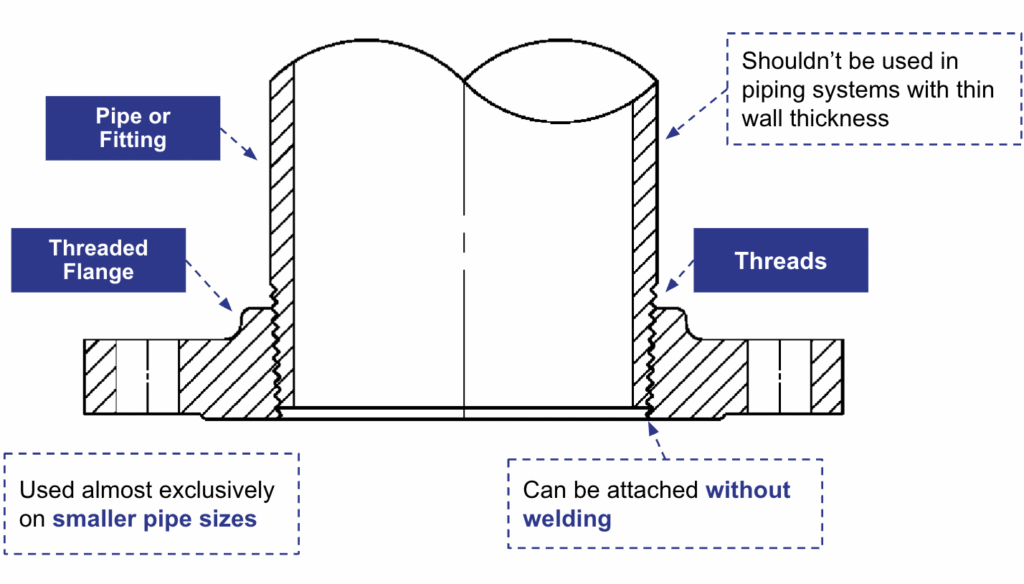
Threaded flange is a type of pipe fitting that connects to a pipe using screw threads instead of welding. The flange has a hole in the center with internal threads, and it fits onto a pipe that has matching external threads. This allows for a tight and secure connection without the need for welding equipment or high-heat processes. Because of this simple process, installation is usually quick and straightforward, which makes these flanges a convenient choice for many basic piping systems. This distinguishes it fundamentally from weld neck, slip-on, or socket weld flanges, each of which requires a weld to join the flange to the pipe.
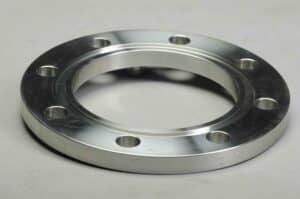
threaded flange diagram

How Is a Threaded Flange Different from Other Flange Types?

To understand where threaded flanges fit, it helps to compare them briefly with the most common flange connection methods:
Flange TypeAttachment MethodWelding Required?Typical Use
Threaded (Screwed)Screwed onto male-threaded pipeNoLow-pressure utility, small bore
Weld NeckButt-welded to pipeYes — full penetrationHigh-pressure, critical service
Slip-OnSlipped over pipe, fillet weldedYes — fillet weldGeneral service, easier alignment
Socket WeldPipe inserted into socket, fillet weldedYes — fillet weldSmall bore, high pressure
BlindBolted to mating flange — no pipeNoLine termination / inspection
Lap JointStub end welded; flange free-floatingYes — stub end weldSystems needing frequent dismantling
* The defining advantage of a threaded flange is the ability to connect pipe without heat — a critical requirement in environments where welding is hazardous (e.g., explosive atmospheres) or structurally impractical.

2. What Is a Companion Flange?

In piping, “companion flange” simply means the mating flange at a bolted joint — informal but universally understood industry language. ANSI/ASME B16.5 does not formally define the word “companion flange.” Outside of piping, the same term refers to a completely different component: the flange at the end of a rotating driveshaft that connects to a differential or gearbox. This guide covers the piping definition only.
When the term ‘threaded companion flange’ is used, it specifically means: a threaded flange designed to mate (bolt) with another flange to form a complete bolted joint, where the pipe-to-flange connection is made by threading rather than welding. 

3. Key Things to Know Before Using Threaded Companion Flanges

Before specifying or installing a threaded flange, engineers and procurement teams need to understand the governing standards, pressure-temperature ratings, available face types, and dimensional systems. What follows is a structured reference for each of these areas.

3.1 Governing Standards

Threaded flanges used in industrial piping are primarily governed by the following standards:
  • ANSI/ASME B16.5 — Pipe Flanges and Flanged Fittings (NPS 1/2 through NPS 24). This is the primary dimensional and pressure-temperature rating standard for most threaded flanges. It covers classes 150 through 2500, materials, facing types, and bolt/stud requirements.
  • ANSI/ASME B16.47 — Large Diameter Steel Flanges (NPS 26 through NPS 60). Covers Series A and Series B flanges for large-bore applications.
  • ASME B1.20.1 — Pipe Threads, General Purpose (Inch). Defines the NPT thread form used in the bore of threaded flanges.
  • MSS SP-44 — Steel Pipeline Flanges. Covers larger-diameter flanges and is referenced within ASME B16.47 Series A.

3.2 Pressure Classes

ASME B16.5 defines seven pressure classes for flanges. Each class designates a maximum allowable working pressure at a reference temperature (usually 100°F / 38°C for carbon steel), with the allowable pressure decreasing as temperature increases.
Class Approx. Max. Pressure @ 100°F (Carbon Steel, Group 1.1) Typical Applications
150 285 psi (19.6 bar) Low-pressure steam, water, utilities
300 740 psi (51.1 bar) General process piping
600 1480 psi (102 bar) Moderate-pressure hydrocarbon service
900 2220 psi (153 bar) Higher-pressure process systems
1500 3705 psi (255 bar) High-pressure hydrocarbon, steam
2500 6170 psi (425 bar) Very high-pressure critical service
* Threaded flanges are most commonly manufactured and used in Class 150, 300, and 600. For Class 900 and above, ASME B16.5 notes that threaded end connections have reduced pressure-temperature ratings compared to weld-end flanges of the same class, because threads weaken the pipe wall and are susceptible to leakage under vibration and thermal cycling.

3.3 Pressure–Temperature Ratings

Pressure ratings are not fixed values and are temperature-dependent. As temperature rises, the allowable pressure decreases due to the reduction in yield strength of the material. The table below provides complete pressure-temperature rating tables for each material group and class.
Example: Class 300, ASTM A105 (carbon steel, Material Group 1.1):
Temperature (°F) Temperature (°C) Max. Pressure (psi)
-20 to 100 -29 to 38 740
200 93 680
400 204 655
600 316 600
800 427 550
Always consult the full ASME B16.5 pressure-temperature table for the specific material group and class in your application. Do not rely on class designation alone.

3.4 Flange Face Types

The face of a flange is the sealing surface where the gasket sits. For threaded companion flanges, the face type must be compatible between both mating flanges and the gasket material selected. ANSI/ASME B16.5 defines the following primary face types:
  • Raised Face (RF): The most common face type. A raised circular area on the flange face concentrates gasket compression. 
  • Flat Face (FF): The seating surface is flush with the flange OD. Used when mating with flat-face flanges on equipment such as cast iron valves or pumps. Full-face gasket required.
  • Ring-Type Joint (RTJ): A machined groove cut into the face accepts a metallic ring gasket. Used in high-pressure and high-temperature applications. Not common for threaded flanges.
* Never mate a Raised Face flange with a Flat Face flange without engineering review. The raised face can crack or damage flat-face cast iron flanges due to uneven load distribution. Always confirm face compatibility before assembly.

3.5 Dimensions and Nominal Pipe Sizes (NPS)

Threaded flange dimensions — including outside diameter (OD), bolt circle diameter (BCD), bolt hole diameter, flange thickness, bore size, and raised face diameter — are standardized in ANSI/ASME B16.5 for sizes NPS 1/2 through NPS 24. Key dimensional reference for threaded flanges (ANSI/ASME B16.5, Class 150, selected sizes):
NPS Flange OD (in) Bolt Circle (in) No. of Bolts Bolt Size (in) Flange Thick. (in)
1/2 3.50 2.38 4 1/2 0.44
1 4.25 3.12 4 1/2 0.50
2 6.00 4.75 4 5/8 0.62
3 7.50 6.00 4 5/8 0.69
4 9.00 7.50 8 5/8 0.75
6 11.00 9.50 8 3/4 0.88
* Note: Dimensions above are representative values. Always verify against the current edition of ANSI/ASME B16.5 Tables for the applicable class and material.

3.6 Materials and Material Groups

The material of a threaded flange must be compatible with the fluid service, operating temperature range, and corrosion environment. ANSI/ASME B16.5 organizes flange materials into material groups which determine the applicable pressure-temperature ratings. The most common materials for threaded flanges are:
Material ASTM Grade Typical Service
Carbon Steel A105 General process, oil, gas, water
Stainless Steel 304 A182 F304 Corrosive service, food, pharma
Stainless Steel 316 A182 F316 Marine, chloride, high-temp corrosion
Chrome-Moly (Alloy) A182 F11 / F22 High-temp steam, refinery
Duplex Stainless A182 F51 Offshore, sour service
* Common threaded flange materials and typical service applications. Always verify material suitability against ANSI/ASME B16.5 pressure-temperature tables and applicable project specifications.

4. How Threaded Flanges Work in Piping Systems

A threaded flange connects to a pipe by screwing onto the externally threaded end of the pipe. The NPT taper thread (per ASME B1.20.1) creates both mechanical engagement and a degree of sealing. However, NPT threads alone are not considered a fully reliable pressure seal for most industrial fluids. Thread sealant compounds (for example PTFE tape) are applied to the male pipe threads before assembly to fill micro-voids between thread flanks and provide a better fluid seal.

The Bolted Joint

Once the threaded flange is made up on the pipe, it connects to the mating companion flange via studs or bolts and nuts, with a gasket between the two faces. The bolted connection follows the same mechanics as any ANSI/ASME B16.5 flanged joint:
  • Studs or bolts pass through matching bolt holes.
  • Nuts are tightened in a cross-bolt sequence to distribute load evenly.
  • Gasket material and construction must be selected based on fluid, temperature, and pressure — spiral wound (SW), ring joint (RTJ), compressed fiber, or full-face rubber depending on service.

Limitations in Dynamic and Cyclic Service

One of the most important engineering limitations of threaded flanges is their vulnerability to leakage under vibration, thermal cycling, and pressure cycling. NPT threads can loosen or develop micro-movement over time under such conditions, eventually compromising the thread seal. For this reason:
  • ANSI/ASME B16.5 restricts the use of threaded flanges in certain elevated-temperature and cyclic-pressure applications.
  • Many engineering specifications (including ASME piping codes) require a seal weld on top of the threaded connection in critical or high-temperature services. 
  • Threaded flanges are generally limited to pipe sizes NPS 2 and smaller in high-pressure services, with NPS 4 being a practical upper limit for most utility applications.

5. What's Better for Sealing? Threaded vs Socket Weld Flanges

Threaded and socket weld flanges occupy similar niches. They are both designed primarily for small-bore piping, but they have meaningfully different sealing performance characteristics.
Criterion Threaded Flange Socket Weld Flange
Welding required? No (can add optional seal weld) Yes — fillet weld required
Sealing mechanism NPT thread taper + sealant compound Fillet weld (full seal)
Vibration resistance Lower — threads can work loose Higher — welded joint is rigid
Thermal cycling Moderate — thread sealant degrades Good — weld tolerates thermal stress
Ease of disassembly High — can be unthreaded if no seal weld Low — weld must be cut to remove
Use in hazardous fluid service Restricted or prohibited in many codes Generally permitted with weld inspection
Corrosion at joint Crevice corrosion risk in thread roots Crevice risk in socket bore; mitigated by gap control
The verdict on sealing: For permanent joints handling hazardous fluids, elevated temperatures, or cyclic loads, socket weld flanges provide a more reliable seal. Threaded flanges excel in non-critical utility services, instrument connections, and where future disassembly is anticipated.

6. Quick-Reference Summary: Threaded Companion Flanges

Parameter

Details / Range

Governing Standard

ANSI/ASME B16.5 (NPS 1/2–24); ANSI/ASME B16.47 (NPS 26–60)

Thread Standard

ASME B1.20.1 (NPT) — most common; 

Pressure Classes Available

150, 300, 600, 900, 1500, 2500 (Note: ratings reduced vs weld-end in class 900+)

Common Pipe Size Range

NPS 1/2 to NPS 4 (practical limit); up to NPS 6 in low-pressure utility

Face Types

Raised Face (RF) most common; Flat Face (FF); Ring-Type Joint (RTJ) for Class 600+

Common Materials

ASTM A105, A182 F304/F316 (SS), A182 F11/F22 (Alloy Steel), A182 F51 (Duplex)

Welding Required?

No for standard installation; optional seal weld for critical/high-temp service

Primary Advantages

No-weld installation; ease of disassembly; suitable for hazardous-atmosphere work zones

Primary Limitations

Susceptible to leakage under vibration/thermal cycling; restricted in hazardous fluid codes at elevated pressure; not used for wellhead service (API 6A)

Key Sealant Requirement

PTFE tape or liquid thread sealant (anaerobic compound) on male threads; seal weld if required by code

Typical Markets / Industries

Oil & gas utilities; water treatment; compressed air; instrumentation; HVAC; small-bore process piping

Conclusion

Threaded companion flanges occupy a well-defined and practical niche in industrial piping: they offer a fast, no-weld connection for small-bore piping in low-to-moderate pressure services. Their limitations are equally well-defined. Under vibration, thermal cycling, or in services involving hazardous fluids at elevated pressure, the thread-sealed connection is inherently less reliable than a welded alternative.
Getting the specification right starts with having the right supplier. Our sales team at API International specializes in navigating complex flange requirements to ensure your system meets its design specifications. Explore our comprehensive range of flanges in our online product catalog, or contact us for custom options tailored to your unique project needs. Get connected with a dedicated sales representative today, or call us at 503.692.3800.