
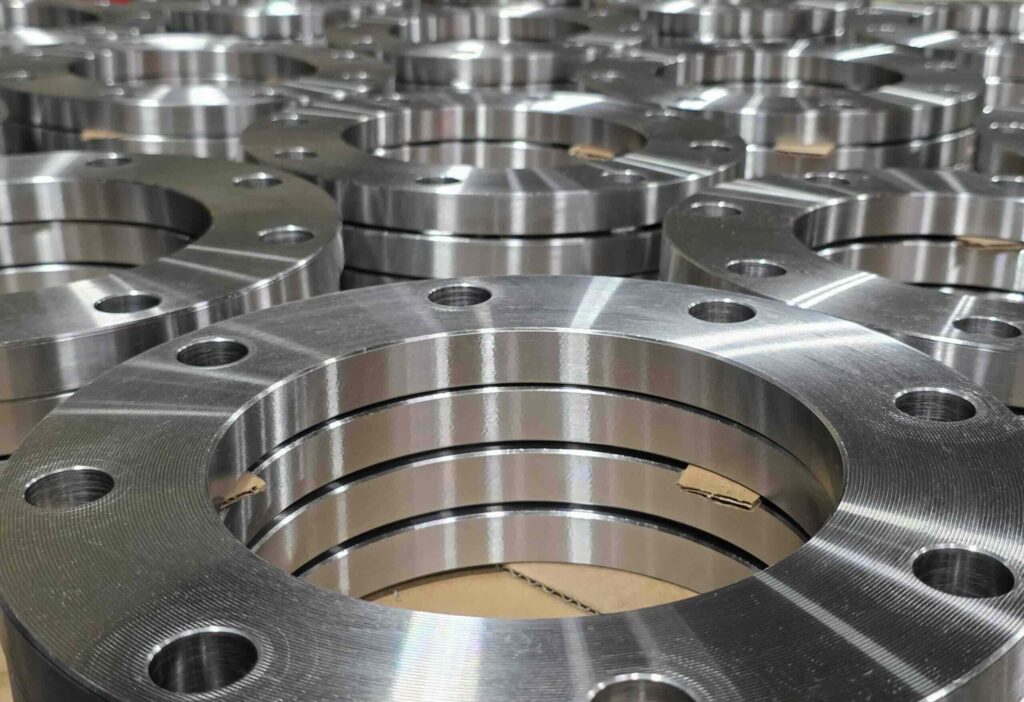
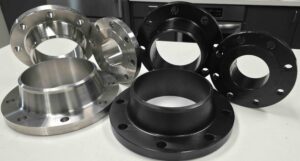
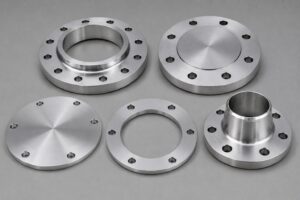
A “plate flange” describes how a flange is manufactured (cut from plate/flat stock), not a universal dimensional standard. The actual dimensions, bolt-hole patterns, facing details, and pressure/temperature rules come from the standard you specify, such as ANSI/ASME B16.5, AWWA C207, or EN 1092-1. Consequently, specifying a flange as “plate” is only the first step in a complete technical procurement. Below is a practical overview of the most common plate flange standards and how to select the right one for your piping system.
1. AWWA C207 and AWWA C228 (Waterworks Standards)
AWWA flange standards are widely specified for waterworks service. They establish consistent dimensional requirements, primarily utilizing plate produced material, and define working pressure classes aligned with municipal and industrial water infrastructure.
AWWA C207 (Steel pipe flanges for waterworks service)
What it covers:
- AWWA C207 provides requirements for steel ring and blind flanges used in waterworks service, including guidance on design intent, dimensional requirements, and testing expectations for flanges used on water systems.
- The standard organizes flanges into working pressure classes intended for common utility operating ranges and typical waterworks applications.
Working pressure classes (typical):
| AWWA C207 Class | Typical working pressure | Notes |
|---|---|---|
| B | up to 86 psi | Low-pressure distribution. |
| D | up to 175 psi (4″–12″), up to 150 psi (>12″) | Common “standard” municipal choice. |
| E | up to 275 psi | Heavy-duty applications. |
| F | up to 300 psi | Highest pressure-rated AWWA class. |
Scope and size range:
- AWWA C207 commonly applies to steel ring-type (slip-on) flanges, blind flanges, and hub flanges in large waterworks applications from 4″ through 144″.
Minimum requirements:
- Materials & fabrication: commonly produced from carbon steel plate suitable for water service (frequently referenced materials include carbon steels such as ASTM A36 or ASTM A105, depending on project requirements and procurement practice).
- Facing expectation: waterworks systems commonly require flat-face compatibility for mating to many types of waterworks equipment (confirm with the mating component and project spec).
- Design basis: intended for steel pipe flanges used on waterworks piping, treatment facilities, pump stations, and related infrastructure.
AWWA C228 (Stainless-steel pipe flange joints for water service)
What it covers:
- AWWA C228 governs stainless-steel ring and blind flanges for water service, with minimum requirements addressing design, materials, and dimensions for stainless-steel flange joints used in potable and non-potable water systems.
- It is commonly used where corrosion resistance is a primary design driver (high humidity, salt exposure, chemical environments, or aggressive water chemistry).
Materials and corrosion resistance:
- Stainless alloy selection is typically driven by corrosion conditions; common references include 304/304L and 316/316L stainless steels (and other alloys where specified).
- The standard’s intent supports long service life in environments where carbon steel may require coatings, linings, or more frequent maintenance.
Scope and size range:
- AWWA C228 is commonly referenced for stainless ring and blind flanges in sizes 2″ through 72″.
Working pressure classes (typical):
| AWWA C228 Class | Pressure rating | Typical sizes | Ideal environments |
|---|---|---|---|
| SA | 50 psi | 2″ to 14″ | Low-pressure, clean water |
| SB | 86 psi | 2″ to 60″ | Water distribution, general use |
| SD | 175 psi (1″–12″), 150 psi (14″–144″) | 2″ to 60″ | Treated water, wastewater |
| SE | 275 psi | 2″ to 72″ | Industrial water loops, tank connections |
| SF | 300 psi | 4″ to 48″ | Marine, chemical, high-pressure zones |
Why AWWA matters for plate flanges:
If your piping system, valves, and mating equipment are built around ANSI/ASME Class and NPS geometry, blind flanges produced from plate material must be cut and machined to ANSI/ASME B16.5 dimensional tables (including the bolt-hole pattern, bolt circle, outside diameter, thickness, and facing requirements). A finished blind flange that is “close” but not made to the correct B16.5 geometry commonly leads to bolt alignment problems, facing mismatch, or gasket seating issues during installation.
2. ANSI/ASME B16.5 (Class-Rated, NPS/inch Systems)
What it covers:
- ANSI/ASME B16.5 establishes requirements for pipe flanges and flanged fittings, including pressure–temperature ratings, materials, dimensional requirements, tolerances, facing options, marking, and testing provisions.
Scope notes (important context for plate flanges):
- ANSI/ASME B16.5 is primarily written around forged or cast flanges and flanged fittings.
- However, certain flange types (most commonly blind flanges) may also be produced from plate material when permitted by the applicable specification and procurement requirements.
Sizing and rating concept:
- Size designation: NPS (Nominal Pipe Size)
- Pressure rating: ANSI/ASME Pressure Class (e.g., Class 150, 300, 400, 600, 900, 1500, 2500)
- In ANSI/ASME systems, the pressure class is not a single fixed pressure value. Allowable pressure varies by material group and operating temperature.
Why it matters for plate flanges:
If your piping system, valves, and mating equipment are built around ANSI/ASME Class and NPS geometry, the plate flange must be cut and machined to ANSI/ASME B16.5 dimensional tables (including the bolt-hole pattern, bolt circle, outside diameter, thickness, and facing requirements). A plate flange that is “close” but not made to the correct B16.5 geometry commonly leads to bolt alignment problems, facing mismatch, or gasket seating issues during installation.
3. DIN EN 1092-1 (PN-rated, DN/Metric Systems)
What it covers:
- DIN EN 1092-1 defines dimensional and drilling requirements for circular steel flanges used with pipes, valves, fittings, and other piping components in DN/PN-based systems.
- The standard covers the core technical elements needed for interchangeability across manufacturers, including: Nominal sizes (DN), Pressure ratings (PN), Flange facing types, Dimensional tolerances, Bolt-hole patterns and bolt counts, Bolt sizes, Marking and materials, and Pressure/temperature (p/T) ratings (critical for real-world allowable limits).
- By standardizing these parameters, EN 1092-1 supports dimensional interchangeability when flanges are matched by DN and PN designation.
Sizing and rating concept (DN and PN):
DIN/EN flange systems use two key identifiers: DN for size and PN for pressure designation.DN: Nominal Diameter
- DN (Nominal Diameter) is a standardized size designation used to keep mating components compatible (pipe, flange, valve, gasket).
- DN should be treated as a matching system reference size, not an exact measured ID/OD value.
PN: Nominal Pressure
- PN (Nominal Pressure) is the pressure designation used by DIN/EN/ISO flange systems (common examples include PN10, PN16, PN25).
- Unlike nominal size, PN directly affects flange geometry, including typical flange thickness conventions, bolt size selection, and bolt-hole patterns.
How EN 1092-1 connects to pressure ratings (p/T concept):
- EN 1092-1 is commonly treated as the reference standard for PN-rated steel flanges across wide DN ranges and PN designations (e.g., PN 2.5 up to PN 400).
- PN is a designation, not a universal fixed pressure across all temperatures.
- EN 1092-1 provides pressure/temperature (p/T) rating tables by material group that define allowable limits at operating temperature.
Why it matters for plate flanges:
In DN/PN-based systems, flanges produced from plate material must strictly adhere to EN 1092-1 geometry standards – specifically bolt pattern, hole count, hole size, thickness conventions, and facing forms associated with the specified DN and PN. The most common field issue is an “almost fits” situation caused by mixing EN 1092-1 PN drilling with ASME (or AWWA) Class drilling (or vice versa). If the system is DN/PN-based, EN 1092-1 must be treated as the controlling standard, regardless of whether the flange is cut from plate or made by another method.
4. Standards Overview
| Standards | Standard / Specification | Typical Use Environment | Why It Matters |
|---|---|---|---|
| AWWA | AWWA C207 / C228 | Waterworks service | Common for municipal and industrial water systems. C207 addresses steel pipe flanges for waterworks service, while C228 covers stainless-steel pipe flange joints for water service applications. |
| ANSI/ASME | ASME B16.5 (Class-rated) | Industrial piping (NPS 1/2–24) | Uses ASME pressure classes (e.g., Class 150, 300, etc.) with standardized dimensions, facing options, and bolt patterns for flanged joints in industrial piping systems. |
| DIN / EN | DIN EN 1092-1 (PN-rated) | Metric / European systems | Uses PN ratings (e.g., PN10, PN16, PN25) with metric drilling and dimensions for DN piping systems, so bolt patterns and flange geometry differ from ASME Class-rated flanges. |
Recommended Standard Selection (Quick Reference):
- Industrial/process piping using NPS and ANSI/ASME Class-rated components → ASME B16.5
- Municipal/utility waterworks projects specified to AWWA → AWWA C207 (carbon steel) or AWWA C228 (stainless steel)
- DN/PN metric systems using PN-rated components → DIN EN 1092-1
5. Conclusion
Flanges produced from plate material offer a practical, versatile solution for projects requiring reliable connections and economical fabrication. Our sales team at API International specializes in navigating complex requirements to ensure no matter which system standard is incorporated (AWWA C207/C228 or ANSI/ASME B16.5), our finished flanges will precisely match your specifications for seamless integration with new or existing pipe, valves, and equipment. Explore our comprehensive range of plate flanges in our online product catalog, or contact us for custom options tailored to your unique project needs. Get connected with a dedicated sales representative today, or call us at 503.692.3800.
Common FAQ
Is “plate flange” itself a standard?
No—“plate flange” describes the fabrication method (cut from plate). The dimensional/rating standard is ASME/AWWA/EN depending on the system.
Which standard is most common for water systems?
AWWA standards are widely used for waterworks service; C207 covers steel pipe flanges for waterworks service, and C228 covers stainless flange joints for water service.
Can I bolt an EN 1092-1 flange to an ASME B16.5 flange?
No. EN 1092-1 and ASME B16.5 are different geometry families (DN/PN vs NPS/Class), so bolt patterns/facing conventions may not match.