
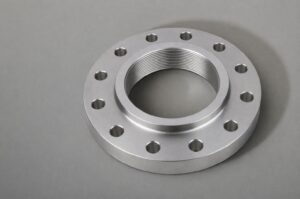
Carbon Steel Flanges: A Brief Overview
| Type | Common Grades | Carbon Content | Notes |
|---|---|---|---|
| Mild / Low Carbon Steel | ASTM A36, Q235 | 0.05–0.30% | Most widely used. Good machinability, ductility, and weldability. |
| Medium Carbon Steel | ASTM A105 | 0.30–0.50% | Stronger than mild steel, used in forged flanges and pressure applications. |
| High Carbon Steel | AISI/SAE 1060–1095 series | 0.60–1.00% | Very strong and hard, but less ductile. Materials are not recommended for flanges. |
| Ultra-High Carbon Steel | W1 and T10 | 1.00–2.00% | Extremely hard and brittle. Materials are not recommended for flanges; they are more common in specialized tooling. |
Carbon Steel Flange Grades
ASTM A36 — Mild Carbon Steel Plate Flanges
ASTM Grade | Product Form | Carbon % | Primary Service | Key Standard |
Plate / structural | 0.05 – 0.29% (varies by thickness) | Low-temp, non-pressure, structural | ASTM A36/A36M | |
Forging | 0.30 – 0.35% | Ambient to high-temp pressure piping | ASTM A105/A105M | |
Forging | Varies by grade | High-pressure oil and gas pipelines | ASTM A694/A694M | |
Plate | 0.15 – 0.31% | Pressure vessels, moderate temp | ASTM A516/A516M |
Key mechanical properties of A36 carbon steel:
- Yield strength: 36,000 psi (250 MPa) minimum
- Tensile strength: 58,000–80,000 psi (400–550 MPa)
- Elongation: 20% minimum (in 8 inches)
- Carbon content: ≤ 0.25% (for plates up to ¾ inch thick)
- Service Temperature: Low-temperature applications
- Product Form: Plate / structural shapes
ASTM A105 — Medium Carbon Forged Flanges
Key mechanical properties of ASTM A105 carbon steel:
- Yield strength: 36,000 psi (250 MPa) minimum
- Tensile strength: 70,000 psi (485 MPa) minimum
- Elongation: 22% minimum
- Carbon content: 0.35% maximum
- Service Temperature: Ambient to elevated temperature (≤ 800°F / 425°C)
- Product Form: Forgings
Carbon Steel Flange Specifications
Applicable Dimensional and Pressure Standards
- ANSI/ASME B16.5 — Covers pipe flanges and flanged fittings from NPS ½” through 24″. Defines flange dimensions, pressure-temperature ratings, materials, and tolerance limits. Pressure classes: 150, 300, 400, 600, 900, 1500, and 2500.
- ANSI/ASME B16.47 — Covers large-diameter flanges from NPS 26″ through 60″, divided into Series A and Series B. Pressure classes: 75, 150, 300, 400, 600, and 900.
- AWWA C207 — Covers carbon steel flanges used in waterworks and related applications up to 300 psi. Applicable to water treatment plants, municipal water mains, and irrigation infrastructure.
- ASME B31.3 — Process Piping Code. Governs design, materials, fabrication, and testing of process piping systems. Specifying A105 forged flanges is required for compliance in most industrial piping applications.
Common Carbon Steel Flange Types
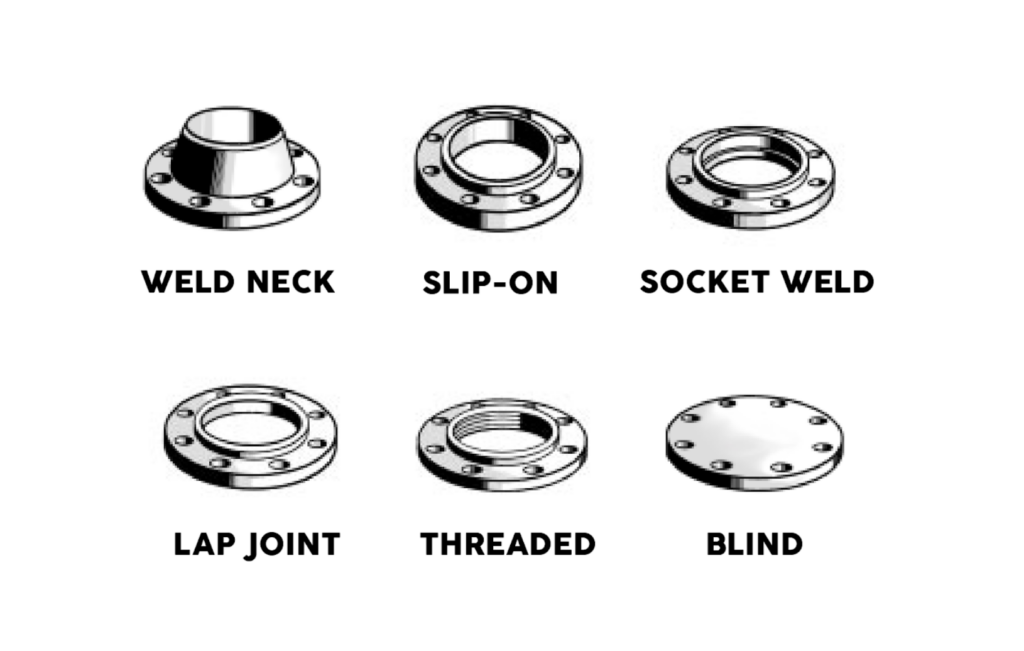
Flange Type | How It Connects | Typical Use | Pressure Suitability |
Butt-welded to pipe via tapered hub | Critical and high-pressure service | High — all pressure classes | |
Pipe slides through bore; fillet welded inside and out | General service, lower pressure | Low to moderate (Class 150–600) | |
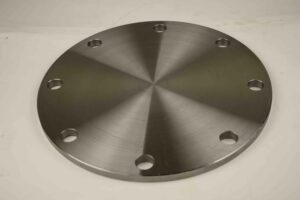
Solid disc; no bore | Pipe termination, isolation | All pressure classes | |
Pipe inserted into socket and fillet welded | Small-bore, high-pressure lines | High (NPS ½ – 3) | |
Threaded connection; no welding required | Low-pressure, non-critical service | Low (Class 150–300) | |
Used with stub ends; flange rotates freely | Systems requiring frequent disassembly | Low to moderate |
Carbon Steel Flange Face Types
Face types determine how the flange seals against its mating component:
- Raised Face (RF) — the most common face type for carbon steel flanges in process piping.
- Flat Face (FF) — used when connecting to cast iron or non-metallic equipment to prevent flange distortion.
- Ring-Type Joint (RTJ) — a metal ring gasket seated in a groove; used in high-pressure and high-temperature service.
What Are Carbon Steel Flanges Used For?
Industry | Typical Application | Common Grade |
Oil and Gas | Pipeline connections, wellhead equipment, refinery process lines | A105, A694 |
Water and Wastewater | Municipal water mains, treatment plants, irrigation systems | A36 (plate), A105 |
Power Generation | Steam lines, cooling water systems, turbine connections | A105 |
Chemical Processing | Process piping, reactor connections, chemical transfer lines | A105 |
HVAC and Ventilation | Large-diameter duct connections, air handling equipment | A36 (fabricated) |
Agriculture | Irrigation mainlines and equipment manifolds | A36 (plate) |
Construction | Structural pipe connections, handrails, pipe supports | A36 |
Carbon Steel Flanges vs. Alloy Steel
Property | Carbon Steel | Alloy Steel |
Alloying elements | Carbon only (no Cr, Ni, Mo) | Chromium, molybdenum, nickel added |
Max service temperature | ~800°F / 425°C (A105) | Up to 1,200°F+ depending on grade |
Corrosion resistance | Low — surface treatment required | Moderate to high (grade dependent) |
Strength at elevated temp | Begins to decrease above 300°F | Maintained to higher temperatures (to above 600°F) |
Common flange grades | A36, A105 | F11, F22 |
Cost | Lower | Higher |
Best for | General service, water, moderate process | High-temp, high-pressure, critical service |
What to Know Before Buying Carbon Steel Flanges
- Service conditions – Pressure, operating temperature, and the media in the line determine grade and pressure class.
- Applicable piping code – ASME B31.3 (process), B31.1 (power), or B31.11 (slurry) each carries specific material and testing requirements that affect your flange specification.
- Correct grade – A36 for fabricated, non-pressure applications, and lower-pressure applications (to 300 psi). A105 for forged, pressure-rated flanges. Do not substitute one for the other in code-governed systems.
- Flange type and face type – Weld neck, slip-on, blind, threaded, socket weld, or lap joint — and raised face, flat face, or RTJ. Both affect fit, sealing, and compatibility with adjacent equipment.
- Dimensional standard – ANSI/ASME B16.5 covers NPS ½” through 24”. ANSI/ASME B16.47 covers 26” through 60”. AWWA C207 governs waterworks applications up to 300 psi.
- Pressure class – Classes 150 through 2500 under ANSI/ASME B16.5. It’s necessary to confirm against the system’s design pressure and temperature rating.
- Requiring certified MTRs – Certified mill test reports confirm chemistry and mechanical properties. It’s important to request them at the time of order on any quality-controlled project, not after delivery.
- Domestic vs. Imported material – Federal and state contracts under Buy American provisions require domestically produced steel. Domestic A105 and A36 flanges also offer better traceability and shorter lead times.
Conclusion
Frequently Asked Questions
What are carbon steel flanges?
Carbon steel flanges are pipe connection components made from steel with 0.05–2.1% carbon content. They provide strong, durable, and economical joints in industrial piping systems. They are commonly used in power generation, water treatment, chemical processing, construction, and general industrial applications.
What is the difference between carbon steel and stainless steel flanges?
The main difference is corrosion resistance. Stainless steels contain additional elements including chromium, which forms a protective oxide layer that resists rust and chemical attack, making it ideal for corrosive or sanitary environments. Carbon steel, while stronger and more economical, is more prone to rust and usually requires protective coatings for long-term usage.
What grade of steel is used in flanges?
What are carbon steel fittings used for?
Carbon steel flanges and fittings are used to connect, redirect, branch, and terminate piping across a wide range of industrial and utility systems. Common applications include power generation, water and wastewater treatment, HVAC systems, mining, agriculture and irrigation, marine, and lumber and pulp processing.
How to order CS flanges from API International?
To order CS flanges from API International, determine your required pipe size, pressure class, material, and any special standards (such as ANSI/ASME B16.5, or thread style). Contact API International’s experienced team and we will help you select the right flange for your application.