
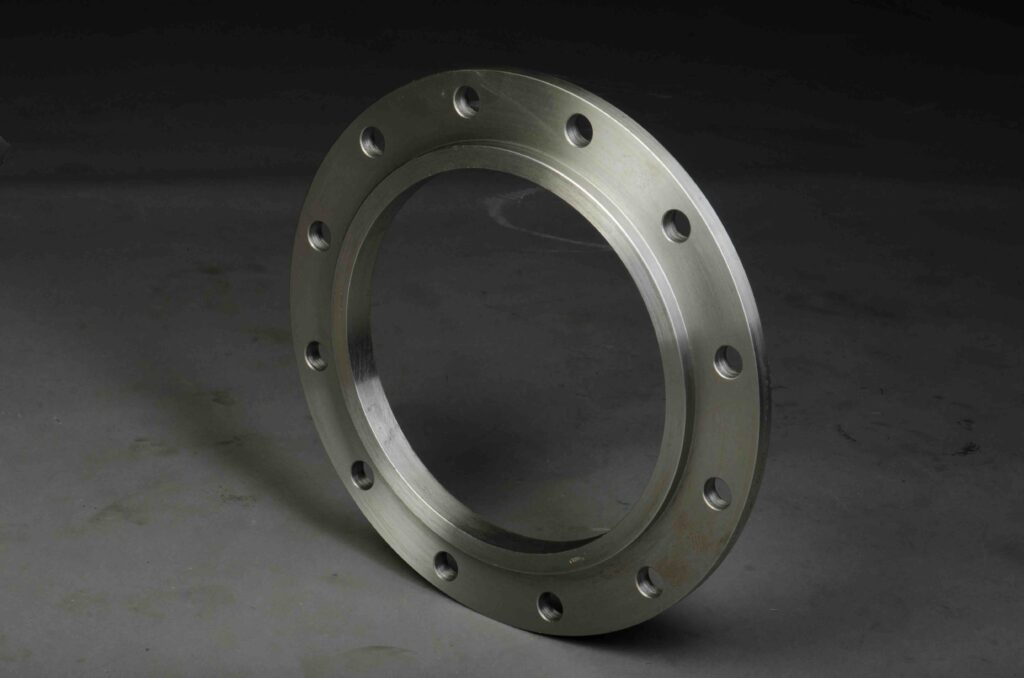
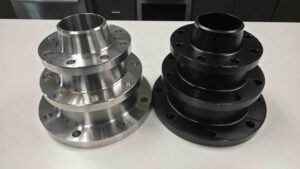
In piping projects, slip-on flanges offer several key benefits: lower cost, easier installation, standardized pressure ratings, and the ability to handle large-diameter lines with minimal preparation. They are recognized in standards such as ASME & AWWA, and are available in a wide range of sizes and materials. The advantages of slip-on flanges are summarized below.
1. Simplified Alignment and Faster Fit-Up
Slip-on flanges are designed with a bore slightly larger than the pipe OD, which allows them to slide into place easily. This feature significantly reduces the time required for alignment and tacking, especially on large-diameter lines. Faster fit-up not only shortens installation time but also reduces labor costs. This practice aligns with AWS D1.1 fillet-weld fit-up controls and is consistent with industry guidance on efficient flange installation.
2. Lower Installed Cost (Fewer Prep Steps)
Slip-on flanges use fillet welds instead of full-penetration butt welds. This means that they require less pipe-end beveling and machining. This reduces both shop preparation time and field installation costs. Their standardized dimensions under ASME standards also mean reduced custom machining and easier procurement.
Cost Drivers for Slip-On Flanges
| Factor | Cost Advantage |
|---|---|
| Weld Prep | No full beveling or deep butt-weld preparation needed. |
| Alignment Time | Bore clearance allows quicker setup and tack welding. |
| Standardization | Covered by ASME, AWWA, and other recognized standards, which ensures consistent dimensions without custom machining. |
3. Broad Standards Coverage (Easy Interfacing)
Slip-on flanges are covered under ASME B16.5 standards, which define dimensions, facings, and pressure classes. For waterworks and utility systems, AWWA C207/C228 provides standards for slip-on ring flanges up to 144″, with defined pressure classes for cold-water service.
Table — Common Standards Including Slip-On Flanges
| Standard | Size Range | Pressure Classes | Application Area |
|---|---|---|---|
| ASME B16.5 | ½″–24″ | 150–2500 | Industrial process piping |
| AWWA C207/C228 | 4″–144″ | Classes A–F | Water and wastewater service |
4. Suitability for Large-Diameter Applications
Slip-on flanges are especially effective in large-diameter piping systems, such as water distribution and wastewater treatment plants. AWWA C207 explicitly covers slip-on flanges up to 144″ in diameter, with different class ratings (A, B, D, E, F) depending on pressure requirements. This makes slip-on flanges a cost-effective choice for systems where pressures are moderate, but sizes are substantial. Instead of costly custom solutions, engineers can rely on a standard flange that is readily available and supported by established specifications.
5. Standardized Pressure Classes
Slip-on flanges are covered by established pressure rating tables, so engineers can select a class with confidence instead of doing one-off justifications. In ASME service, pressure–temperature ratings are set in ASME B16.5 (≤24 in). For waterworks, AWWA C207 defines slip-on flange pressure classes for large diameters, and provides quick, code-recognized limits.
ASME B16.5 Pressure–Temperature Ratings (Carbon Steel, ~100 °F)
| Class | Allowable Pressure (psig) | Typical Applications |
|---|---|---|
| 150 | 285 | Low-pressure water, HVAC loops, general utility service |
| 300 | 740 | Process piping, steam lines, moderate chemical service |
| 600 | 1,480 | Refinery piping, higher-pressure water or steam headers |
| 900 | 2,220 | Power plants, petrochemical service with moderate cycles |
| 1500 | 3,705 | High-pressure oil and gas lines, critical plant service |
| 2500 | 6,170 | Very high-pressure industrial systems, specialized energy service |
Common waterworks classes
| Standard | Class | Typical working pressure (psig) | Notes |
|---|---|---|---|
| AWWA C207 | D | 175 (4–12″), 150 (≥14″) | “Standard” municipal service. |
| AWWA C207 | E | 275 | Heavy-duty service. |
| AWWA C207 | F | 300 (up to 300 psig; table allows transient test up to 450 psig) | Highest AWWA class. |
6. Multiple Flange Facing Options
Slip-on flanges are available with Flat Face (FF), Raised Face (RF), and Ring-Type Joint (RTJ) options. This versatility allows engineers to match the flange to the gasket and sealing requirements of the system.
- Flat Face (FF): Typically used in cast iron systems or non-metallic piping.
- Raised Face (RF): The most common type, it provides concentrated gasket load for a secure seal.
- RTJ: For tighter sealing in higher pressure or specialized applications.
7. Material Versatility (Process Compatibility)
| Material / Class | Key Grades / Examples | Performance Characteristics | Typical Application Domains |
|---|---|---|---|
| Carbon Steel | ASTM A105, A36 | Good strength up to ~425 °C; low corrosion resistance, needs coatings or protection | Oil & gas, steam, water, HVAC, general industry |
| Stainless Steel | 304L, 316L, F55 (UNS S23760) | High corrosion resistance; good strength across moderate temps | Chemical, food, marine, offshore, desalination |
| Alloy Steel | Different types of alloys | Excellent strength and creep resistance at high temps; moderate corrosion resistance | Power plants, refineries, high-temp steam service |
| Cast / Ductile Iron | ASTM A126 and A48 (cast), ASTM A536 (ductile) | Adequate strength for low-pressure; ductile iron tougher; poor corrosion resistance | Water, wastewater, utilities, low-pressure piping |
| Nickel Alloys | Inconel 625, Monel 400, Hastelloy | Outstanding high-temp and corrosion resistance; stable under stress and harsh chemicals | Offshore, subsea, chemical, high-temp reactors |
| Duplex / Super Duplex | 2205, 2507 | Very high strength; excellent resistance to chlorides and stress corrosion cracking | Marine, oil & gas, subsea, desalination |
| Aluminum | 6061-T6, ASTM B247 | Lightweight; moderate corrosion resistance; limited strength/temp | Irrigation, HVAC, lightweight piping |
| Titanium | ASTM B381 | Excellent seawater resistance; high strength-to-weight; good corrosion performance | Marine, desalination, aerospace, heat exchangers |
8. Maintenance and Operational Accessibility
Because slip-on flanges are bolted connections, they can be disassembled for inspection, cleaning, or equipment replacement more easily than fully welded joints. This advantage is particularly valuable in process industries and utilities where frequent inspection or maintenance is required.
Maintenance Tips for Slip-On Flanges:
- Regular Bolt Torque Checks – Periodic torque verification helps maintain joint integrity.
- Gasket Inspection – During disassembly, gaskets should always be checked and replaced if there are signs of creep, extrusion, or corrosion.
- Surface Cleaning – Flange faces should be cleaned before reassembly to prevent leakage from debris or corrosion pits.
- Corrosion Monitoring – In water, steam, or chemical service, the weld areas and flange bore should be inspected for signs of localized corrosion.
- Use of Protective Coatings – In corrosive or marine environments, applying anti-corrosion coatings or selecting stainless/alloy slip-ons helps extend service life.
Where Slip-On Flanges Work Best
| Parameter | Suitable for Slip-On Flanges | Not Recommended |
|---|---|---|
| Pressure Class | ≤ Class 300 (ASME); AWWA Classes D–F | ≥ Class 600; frequent surge pressures |
| Pipe Geometry | Large-diameter, straight runs with support | Long spans with high vibration/bending |
| Temperature | Moderate (below ~500 °F) | Elevated/high cycling environments |
| Maintenance | Systems requiring periodic disassembly | Sealed or critical zero-leak systems |
Conclusion
The ability of slip-on flanges to simplify both installation and future maintenance keeps them widely used across different industries. Our sales team at API International can answer any questions about your flange requirements. Depending on its application, they can also recommend alternative products that may be better suited for your system. We also provide custom flange solutions tailored to your project specifications. Get connected with a dedicated sales representative today! Or call us at 503.692.3800.