
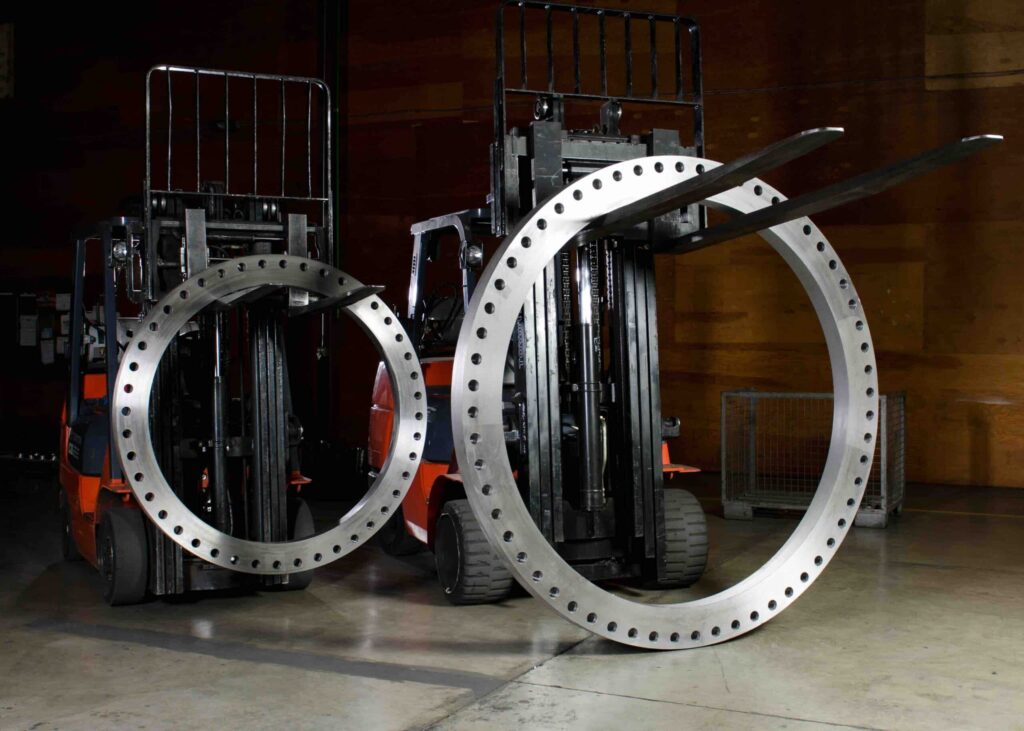

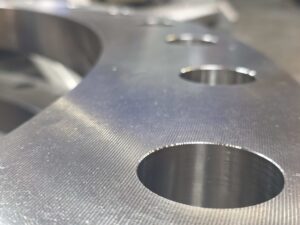
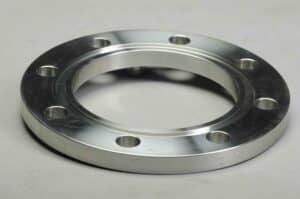
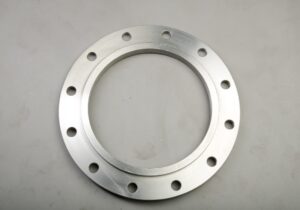
In 2023, The American Water Works Association (AWWA) has issued a specification revision affecting the bolt hole diameter for 22″ Class-F flanges. This revision is applicable to Carbon Steel (AWWA C207 Class F) and Stainless Steel (AWWA C228 Class SF) materials, in both Slip-On and Blind configurations. It means that engineers, procurement teams, and contractors working with this size and class should review the change and confirm alignment with current drawings and inventory.
What Changed for AWWA Class F Flanges?
For 22″ AWWA Class-F flanges, the diameter of bolt specification was revised (affecting the bolt hole diameter):
- Previous Spec: Bolt size: Ø 1.25″ (Bolt hole diameter: Ø 1.375″)
- New 2023 Spec: Bolt size: Ø 1.500″ (Bolt hole diameter: Ø 1.625″)
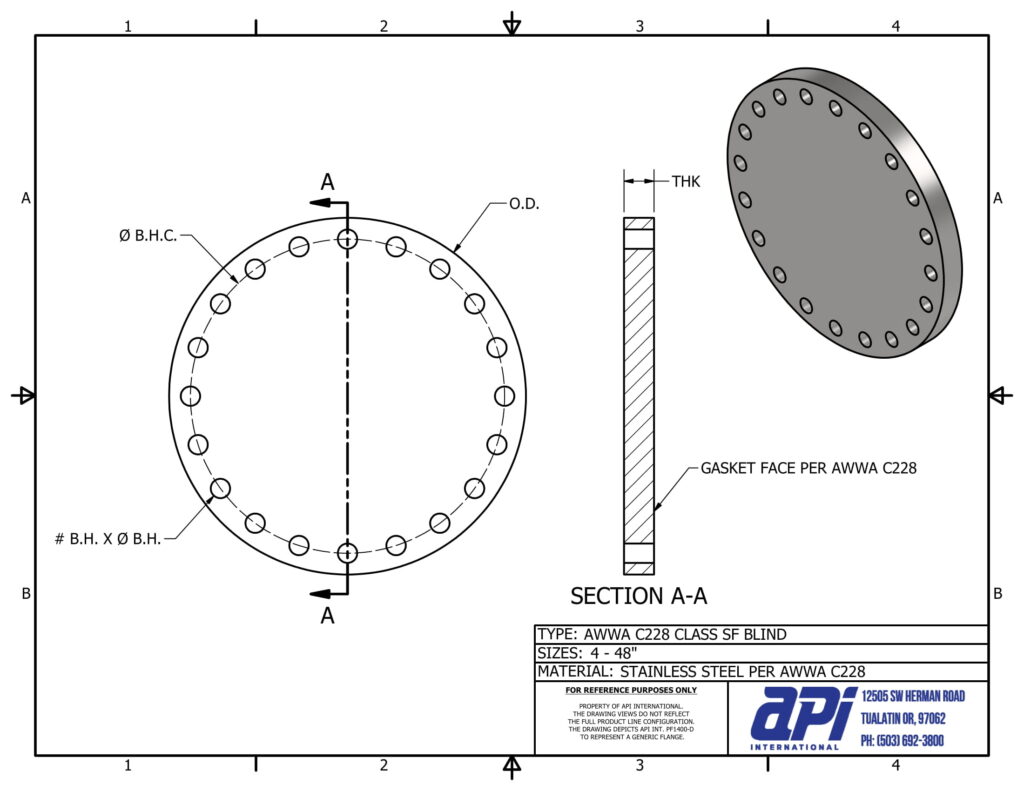
Background: AWWA C207 and C228 Standards
- Dimensions — outside diameter, inside diameter, bolt hole circle, resultant bolt hole diameter (based on bolt diameter), and thickness
- Pressure classes — Classes B (SB) through F (SF), covering pressure ratings from 86 psi up to 300 psi. There is also Class SA, which covers a 50 psi pressure rating.
- Material requirements — carbon/mild steel (C207) and stainless steel in 304/304L or 316/316L grades (C228)
- Drilling compatibility — bolt patterns that align with ASME/ANSI Class 150 (Classes B–E) or Class 300 (Class F)
AWWA Flange Pressure Classes
| Class | Pressure Rating | Bolt Pattern |
|---|---|---|
| Carbon Steel — AWWA C207 | ||
| B | 86 psi | ASME/ANSI Class 150 |
| D | 150–175 psi | ASME/ANSI Class 150 |
| E | 275 psi | ASME/ANSI Class 150 |
| F | 300 psi | ASME/ANSI Class 300 |
| Stainless Steel — AWWA C228 | ||
| SA | 50 psi | ASME/ANSI Class 125/150 |
| SB | 86 psi | ASME/ANSI Class 150 |
| SD | 150–175 psi | ASME/ANSI Class 150 |
| SE | 275 psi | ASME/ANSI Class 150 |
| SF | 300 psi | ASME/ANSI Class 300 |
Class F is the highest-rated AWWA class, designed for up to 300 psi service, which makes bolt hole accuracy especially critical. At 300 psi, joint integrity depends on proper bolt engagement across all holes.
What Is Bolt Hole Alignment and Why Does It Matter?
- Match the correct bolt hole diameter (Ø B.H.) for the specified bolt size
- Be positioned accurately on the bolt hole circle — the centerline diameter on which all holes fall
- Be symmetrically spaced so that mating flanges align when brought together in the field
Scope of Impact
- Municipal water transmission lines using large-diameter flanged connections
- Pump stations and treatment plants with 22″ flanged isolation or connection points
- Replacement or repair situations where new flanges must mate with existing ones
- Design projects currently specifying 22″ Class-F where drawings or BOMs may reference the old bolt hole diameter
Class-F Flanges Available from API International
- PF2200-F — 22″ Carbon Steel Ring Flange (C207), 300 psi
- PFBL2200-F — 22″ Carbon Steel Blind Flange (C207), 300 psi
- SPF2200-F — 22″ Stainless Steel Ring Flange (C228), 300 psi
- SPFBL2200-F — 22″ Stainless Steel Blind Flange (C228), 300 psi
Related Products
-
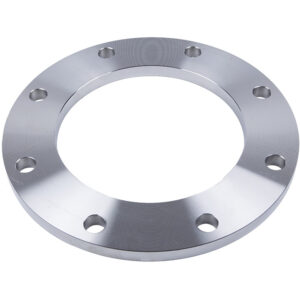
AWWA Class SF Stainless Steel Ring Flanges
This product has multiple variants. The options may be chosen on the product page -
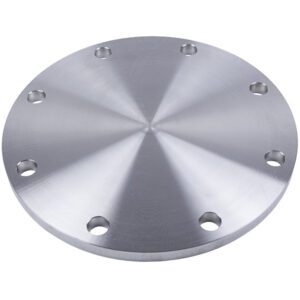
AWWA Class SF Stainless Steel Blind Flanges
Add to Quote -
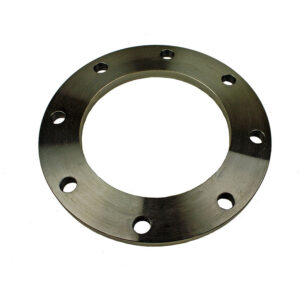
AWWA Class F Steel Ring Flanges
This product has multiple variants. The options may be chosen on the product page -
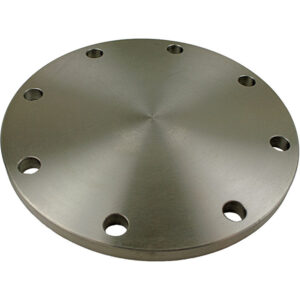
AWWA Class F Steel Blind Flanges
This product has multiple variants. The options may be chosen on the product page
Frequently Asked Questions
What is the difference between AWWA C207 and C228?
What is the pressure rating of AWWA flanges?
Pressure ratings vary by class:
- Class SA: up to 50 psi (Stainless Steel Only)
- Class B: up to 86 psi
- Class D: up to 175 psi
- Class E: up to 275 psi
- Class F: up to 300 psi
These ratings apply to water service and depend on flange size and material.
What are AWWA C207 Class F flange dimensions?
What is the pressure rating of AWWA C207 Class F?
What are the dimensions of AWWA C228 Class SF flanges?
AWWA C228 Class SF flange dimensions are defined by:
- Nominal pipe size (NPS)
- Outside diameter (OD)
- Bolt circle (BC)
- Number of bolt holes
- Hole diameter
- Thickness