
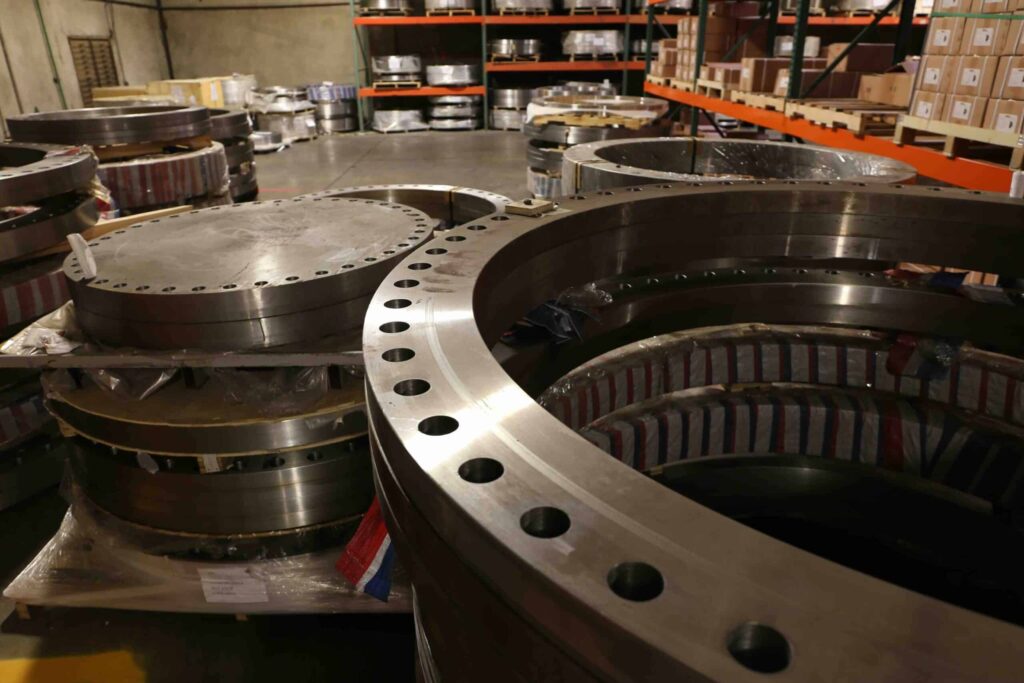


Carbon steel and alloy steel flanges serve different purposes based on the demands of the piping system. Both of them share a common structural base, but each is engineered for a different kind of service. Carbon steel delivers reliable strength and weldability at a lower cost, while alloy steel’s added elements extend performance into higher temperatures and more demanding conditions. This guide breaks down what separates the two grades, how each is classified, and when each is the correct specification.
Alloy Steel vs Carbon Steel Flanges: The Basics
What Is a Carbon Steel Flange?
Carbon steel flanges derive their strength from carbon content alone, with no significant alloying elements added. The two most common grades are ASTM A105, a forged grade rated for pressure piping up to 800°F, and ASTM A36, a plate grade used in non-pressure structural and waterworks applications. Full mechanical and chemical requirements for both are published by ASTM International in ASTM A105/A105M and ASTM A36/A36M. Both grades are covered in detail in our guide to carbon steel flange grades.
What Is an Alloy Steel Flange?
Alloy steel flanges are forged carbon steel with chromium and molybdenum added to the chemistry, governed by ASTM A182/A182M. The added elements change the steel’s behavior at high temperature: chromium improves oxidation and corrosion resistance, and molybdenum increases creep strength (the ability to resist slow deformation under sustained load and heat). The most common grades are known by their chrome-moly ratio, forged under ASTM A182/A182M and dimensioned to the same ANSI/ASME B16.5 and ANSI/ASME B16.47 standards as carbon steel flanges. The difference is entirely in chemistry and heat treatment.
Grade | Composition | Approx. Max Temp | Typical Application |
F11 | 1.25% Cr, 0.5% Mo | ~1,025°F (550°C) | Moderate high-temperature steam and process piping |
F22 | 2.25% Cr, 1% Mo | ~1,100°F (595°C) | High-pressure hydroprocessing units, high-temperature steam systems |
F91 | 9% Cr, 1% Mo, V, Nb | ~1,100°F+ (595°C+) | Superheater and reheater systems, ultra-high-temperature service |
Alloy Steel vs Carbon Steel Flanges: The Main Differences
Carbon steel flanges handle the large majority of industrial piping applications. Alloy steel flanges are specified when service conditions exceed what carbon steel can reliably handle: higher temperature, higher pressure, or hydrogen and corrosive service.
| Property | Carbon Steel | Alloy Steel |
| Alloying elements | Carbon, Manganeese and other trace chemicals (no CR, Ni, Mo) | Chromium and molybdenum added (Cr-Mo) |
| Governing ASTM standard | A105 (forged), A36 (plate) | A182 (forged) |
| Max service temperature | ~800°F / 425°C (A105) | ~1,025–1,100°F depending on grade |
| Corrosion / oxidation resistance | Low — no built-in resistance | Improved with higher chromium content |
| Creep strength at elevated temp | Declines above ~800°F | Maintained to higher temperatures by design |
| Common flange grades | A36, A105 | F11, F22, F91 |
| Cost | Lower | Higher |
| Best for | General service, water, moderate-temperature process | High-temperature steam, high-hydrogen-pressure process, critical service |
! Temperature values are approximate; consult current B16.5 pressure-temperature tables for design.
Why Chromium Content Matters
In high-pressure hydroprocessing service, the choice between F11 and F22 often comes down to more than temperature. Higher hydrogen partial pressure at elevated temperature can cause high-temperature hydrogen attack (HTHA), a form of internal material damage where hydrogen reacts with carbon in the steel to form methane bubbles, weakening the material from within.
Industry practice defines temperature and hydrogen partial pressure limits at which different steel grades resist HTHA. Because F22’s higher chromium content improves resistance at higher hydrogen partial pressures and temperatures than F11, it is the standard specification for hydroprocessing reactor flanges and nozzle forgings, even in services where F11 would otherwise be adequate on temperature alone.
When to Specify Alloy Over Carbon Steel
Work through these factors when deciding whether a flange needs to be alloy steel:
- Operating temperature. Above 800°F, carbon steel A105 no longer applies. Move to F11, F22, or F91 depending on exact temperature and design pressure.
- Hydrogen service. Processing units at elevated hydrogen partial pressure require higher chromium content to resist internal hydrogen attack, regardless of temperature alone.
- Creep and long-term strength. Systems under sustained load and heat for years of service need a grade engineered for creep resistance.
- Cost and lead time. Alloy steel costs more and often has longer lead times. Specify it only where service conditions genuinely require it.
Conclusion
Carbon steel flanges cover the majority of industrial piping needs at the lowest cost. Alloy steel flanges exist for the applications carbon steel cannot handle: sustained high temperature, creep-sensitive service, and hydrogen-rich process environments. Matching the grade to the actual service condition, not just the pressure class, is what keeps a piping system safe and code-compliant over its service life.
API International supplies carbon steel flanges, machined to ASTM A105 material requirements and dimensioned per ANSI/ASME B16.5 and ANSI/ASME B16.47. Explore our full range in the online product catalog, or contact us for custom machining. Get connected with a dedicated sales representative today, or call us at 503.692.3800.
Related Products
-
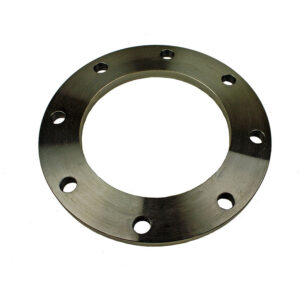
AWWA Class F Steel Ring Flanges
This product has multiple variants. The options may be chosen on the product page -
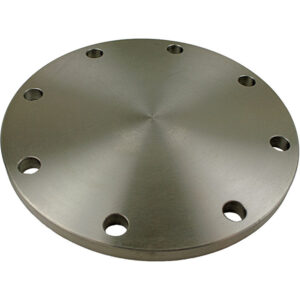
AWWA Class F Steel Blind Flanges
This product has multiple variants. The options may be chosen on the product page -
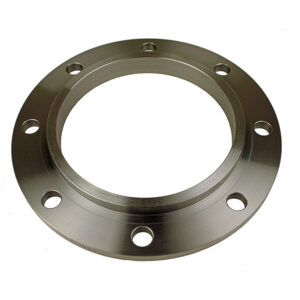
AWWA Class E Steel Hub Ring Flanges
This product has multiple variants. The options may be chosen on the product page -
AWWA Class D Steel Hub Ring Flanges
This product has multiple variants. The options may be chosen on the product page
Frequently Asked Questions
What is the main difference between alloy steel and carbon steel flanges?
Carbon steel flanges contain no significant chromium, nickel, or molybdenum, which limits their service temperature to around 800°F. Alloy steel flanges add chromium and molybdenum, raising the temperature ceiling above 1,000°F and improving corrosion and hydrogen attack resistance.
What is the difference between F11 and F22 alloy steel flanges?
F11 contains 1.25% chromium and 0.5% molybdenum, while F22 contains roughly twice that amount at 2.25% chromium and 1% molybdenum. The higher chromium content in F22 provides better resistance to high-temperature hydrogen attack, which is why it is the standard choice for refinery hydroprocessing units even when F11 would handle the temperature alone.
When should alloy steel flanges be used instead of carbon steel?
Alloy steel is specified when sustained operating temperature exceeds the roughly 800°F limit of carbon steel A105, when the system involves elevated hydrogen partial pressure, or when long-term creep resistance under sustained load and heat is required.
What is high-temperature hydrogen attack (HTHA)?
HTHA is a form of internal material damage in which hydrogen at elevated temperature and pressure reacts with carbon inside the steel to form methane bubbles, weakening the material from within. Industry practice defines the temperature and hydrogen partial pressure limits at which different steel grades resist this damage.
Are alloy steel flanges dimensioned differently than carbon steel flanges?
No. Alloy steel flanges follow the same ANSI/ASME B16.5 and ANSI/ASME B16.47 dimensional standards as carbon steel. The difference is the material specification (ASTM A182 for alloy versus A105 for carbon) and the pressure-temperature rating table, since alloy grades fall under a different ASME material group.