
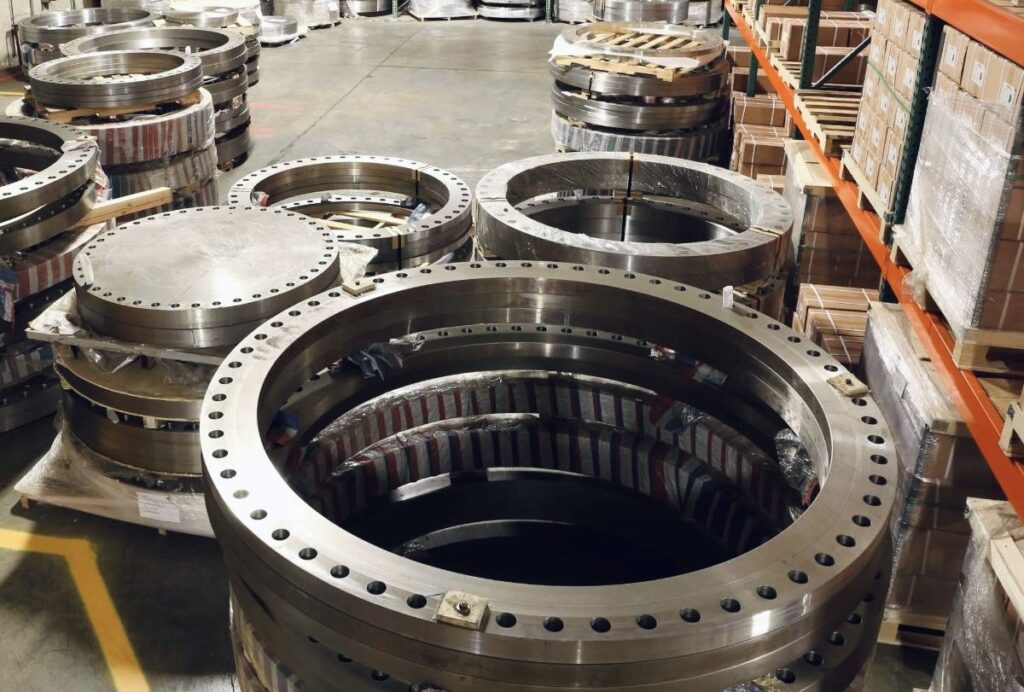
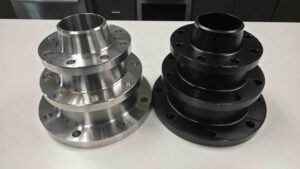
What Is ASTM A105 Carbon Steel?
Key Mechanical Properties
- Yield strength: 36,000 psi (250 MPa) minimum
- Tensile strength: 70,000 psi (485 MPa) minimum
- Elongation (2 inches): 22% minimum
- Reduction of area: 30% minimum
- Brinell hardness: 187 HBW maximum (non-normalized); 197 HBW maximum (normalized)
- Carbon content: 0.35% maximum
- Product form: Forgings
Chemical Composition
- Manganese (Mn): 0.60 – 1.05%
- Silicon (Si): 0.10 – 0.35%
- Phosphorus (P): 0.035% maximum
- Sulfur (S): 0.040% maximum
- Copper (Cu): 0.40% maximum
- Nickel (Ni): 0.40% maximum
- Chromium (Cr): 0.30% maximum
- Molybdenum (Mo): 0.12% maximum
- Vanadium (V): 0.08% maximum
- Niobium (Nb): 0.02% maximum
Chemical Composition Notes:
- For each reduction of 0.01% below the specified carbon maximum (0.35%), an increase of 0.06% manganese above the specified maximum (1.05%) is permitted, up to a maximum of 1.65% Mn.
- The sum of Copper, Nickel, Chromium, Molybdenum, and Vanadium shall not exceed 1.00%.
- The sum of Chromium and Molybdenum shall not exceed 0.32%
Applicable Standards and Industry Standards
Dimensional and Pressure Standards
- ANSI/ASME B16.5 — ANSI/ASME B16.5 applies to pipe flanges from NPS ½” through NPS 24″. It defines flange dimensions, pressure-temperature ratings, tolerance limits, and material groups. A105 falls under Group 1.1. Pressure classes covered: 150, 300, 400, 600, 900, 1500, and 2500.
- ANSI/ASME B16.47 — ANSI/ASME B16.47 covers large-diameter weld neck and blind flanges from NPS 26″ through NPS 60″, divided into Series A and Series B. Pressure classes covered: 75 (Series B only), 150, 300, 400, 600, and 900.
- ASME B31.3 — The Process Piping Code governs the design, materials, fabrication, and testing of process piping systems. A105 forged flanges are the required carbon steel material for compliance in most industrial process piping applications.
Pressure-Temperature Ratings (Class 150, Group 1.1 per ANSI/ASME B16.5)
| Temperature (°F) | Max Allowable Pressure (psig) | Temperature (°F) | Max Allowable Pressure (psig) |
|---|---|---|---|
| -20 to 100 | 285 | 500 | 170 |
| 200 | 260 | 600 | 140 |
| 300 | 230 | 700 | 110 |
| 400 | 200 | 800 | 80 |
Where Are A105 Flanges Used?
- Process piping systems governed by ASME B31.3 — chemical plants, refineries, and processing facilities
- Power piping systems governed by ASME B31.1 — steam lines, boiler connections, and turbine piping
- Oil and gas surface facilities, gathering systems, and refinery process lines
- Chemical processing plants, petrochemical facilities, and pharmaceutical manufacturing
- Steam distribution and elevated-temperature service up to 800°F
- Power generation facilities — cooling systems, heat exchangers, and utility connections
- Municipal water infrastructure requiring ASME-rated pressure components
A105 vs. A36: Key Differences
Property | ASTM A105 | ASTM A36 |
Carbon category | Medium carbon (0.25% – 0.29% max – varies by thickness) | Mild / low carbon (0.26% max) |
Product form | Forgings | Plate / structural shapes |
Yield strength | 36,000 psi minimum | 36,000 psi minimum |
Tensile strength | 70,000 psi minimum | 58,000 – 80,000 psi |
Grain structure | Forged — denser, more uniform | Rolled plate — less dense |
Max service temperature | 800°F / 425°C | Ambient / Non-critical temperatures |
Pressure service (code) | Yes — ASME B31.3 compliant | Restricted (AWWA waterworks up to 300 psi) |
ASME B16.5 qualified | Yes — Group 1.1 | No |
Primary use | Pressure-rated forged flanges | Fabricated, medium-pressure flange applications (to 300 psi) |
Typical application | Process piping, refineries, steam | Water systems, HVAC, structural |
! The material decision should follow the service requirement, not the price point.
Common A105 Flange Types
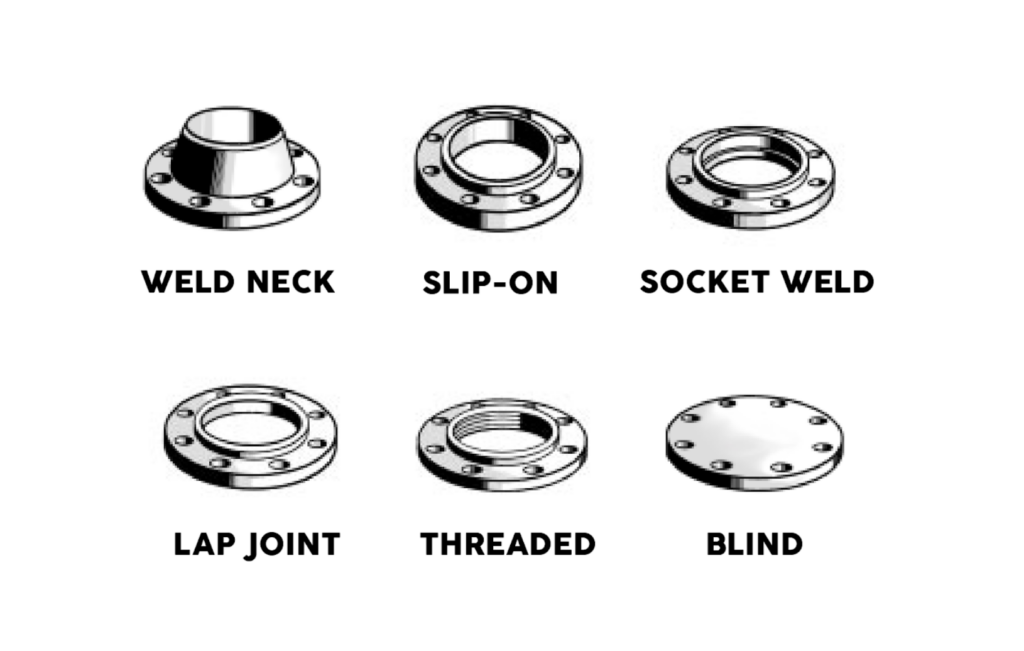
- Weld neck flanges provide the highest structural integrity of any flange type. The tapered hub transitions stress from the flange to the pipe wall. This is the preferred choice for all pressure classes (Class 150 through 2500) in process and industrial piping. The pipe is butt-welded to the hub with a full-penetration weld. Weld neck A105 flanges are standard in refineries, chemical plants, and steam systems.
- Slip-on flanges are the most commonly specified A105 configuration for general-service piping. The pipe slides through the bore and receives fillet welds on both the inside and outside faces. They are easier to align than weld neck flanges and more economical to produce.
- Blind flanges are solid discs used to close off a pipe end, nozzle, or vessel connection. In pressure service, blind flanges carry the full system pressure across their face. Refineries and processing plants use A105 blind flanges.
- Socket weld flanges are used on small-bore piping, typically NPS ½” through 2″. The pipe is inserted into a socket bore and secured with a fillet weld. They provide a strong, leak-resistant connection.
- Threaded flanges connect to pipe via a threaded bore. No welding is required. They are used in low-pressure utility lines, test connections, and certain chemical service applications.
- Lap joint flanges are used in combination with stub ends. The flange slides freely over the pipe and rotates for bolt hole alignment. They are common in piping systems with corrosion-resistant linings.
Flange Face Types
Why Buy Domestic A105 Flanges?
1. Material Traceability
2. Reliable Lead Times
3. Buy American Compliance
4. Consistent Quality and Standards Compliance
What to Confirm Before Ordering
- Service conditions. Operating pressure, temperature, and the media in the line determine pressure class and whether A105 is appropriate or whether an alloy grade is required.
- Applicable piping code. ASME B31.3 (process), B31.1 (power), and equivalent codes each carry specific material and documentation requirements that govern the flange specification.
- Flange type. Weld neck, slip-on, blind, socket weld, threaded, and lap joint configurations each have different structural characteristics. The service condition and piping system design determine which is appropriate.
- Face type. Raised face, flat face, and ring-type joint each require specific gasket types and compatible mating flanges. A mismatch here means the joint cannot be assembled correctly.
- Pressure class. Classes 150 through 2500 under ANSI/ASME B16.5. Class selection is based on design pressure and operating temperature from the B16.5 pressure-temperature tables.
- Dimensional standard. ANSI/ASME B16.5 covers NPS ½” through 24″. ANSI/ASME B16.47 covers NPS 26″ through 60″. Series A or B must be specified for B16.47 flanges.
- Certified MTRs. MTR requirements should be specified at time of order on any quality-controlled project. Retroactive requests after delivery delay fabrication and inspection.
- Heat treatment condition. While standard A105 can be supplied “as-forged” for small, low-pressure components (like Class 150 items under NPS 4), ASTM A105 mandates normalizing or tempering heat treatments for all Class 300 flanges over NPS 4 and all flanges in Classes 400 through 2500. Ensure any project-specific heat treatment or optional Charpy impact testing is explicitly called out on your purchase order.
Summary
Related Products
-
AWWA Class F Steel Ring Flanges
This product has multiple variants. The options may be chosen on the product page -
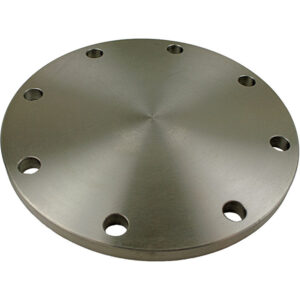
AWWA Class F Steel Blind Flanges
This product has multiple variants. The options may be chosen on the product page -
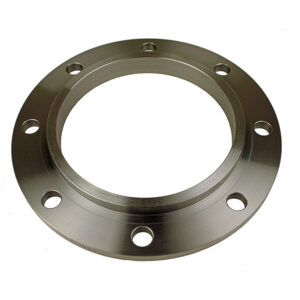
AWWA Class E Steel Hub Ring Flanges
This product has multiple variants. The options may be chosen on the product page -
AWWA Class D Steel Hub Ring Flanges
This product has multiple variants. The options may be chosen on the product page
Frequently Asked Questions
What is ASTM A105?
ASTM A105 is a specification published by ASTM International for carbon steel forgings used in pressure piping. It covers flanges, fittings, valves, and similar components for ambient and elevated temperature service. A105 is the material referenced in ANSI/ASME B16.5 and ANSI/ASME B16.47 — the primary dimensional standards for pressure-rated carbon steel pipe flanges.
What is the difference between A105 and A36 carbon steel flanges?
A105 is a medium carbon forged steel specified for pressure-rated flanges under ASME piping codes. A36 is a mild carbon plate steel used for fabricated, medium-pressure flange applications (to 300 psi) in water systems, HVAC, and structural applications. They share the same minimum yield strength (36 ksi) but A105 has a higher minimum tensile strength (70 ksi vs. 58 ksi) and qualifies under ANSI/ASME B16.5. They are not interchangeable in pressure piping. See our post on domestic A36 flanges for full details.
Do I need mill test reports (MTRs) for A105 flanges?
On any quality-controlled or code-governed project, yes.
Certified mill test reports (MTRs) confirm that the forging meets ASTM A105 chemistry and mechanical requirements. MTRs are required for ASME code-stamped fabrications, most refinery and chemical plant procurement, and any project with third-party inspection. Request them at time of order.
What is the difference between ANSI/ASME B16.5 and ANSI/ASME B16.47 for A105 flanges?
There is no difference in A105 material between ANSI/ASME B16.5 and B16.47. A105 is available in all standard flange configurations: weld neck, slip-on, blind, socket weld, threaded, and lap joint. All configurations are available in raised face, flat face, and ring-type joint face types. Availability across pressure classes and sizes varies by supplier and stock levels.
Can A105 flanges be used in water systems?
Yes.
While A105 is most commonly associated with process piping, it is also used in municipal water systems and industrial water treatment where ASME-rated flanges are specified. For lower-pressure waterworks applications governed by AWWA C207 (up to 300 psi), A36 plate flanges are more commonly used due to cost. For ASME-rated water piping, A105 is the correct forged grade.
How to order A105 flanges from API International?
To order A105 carbon steel flanges from API International, determine your required pipe size, pressure class, and any special standards (such as ANSI/ASME B16.5). Contact API International’s experienced team and we will help you select the right flange for your application.