
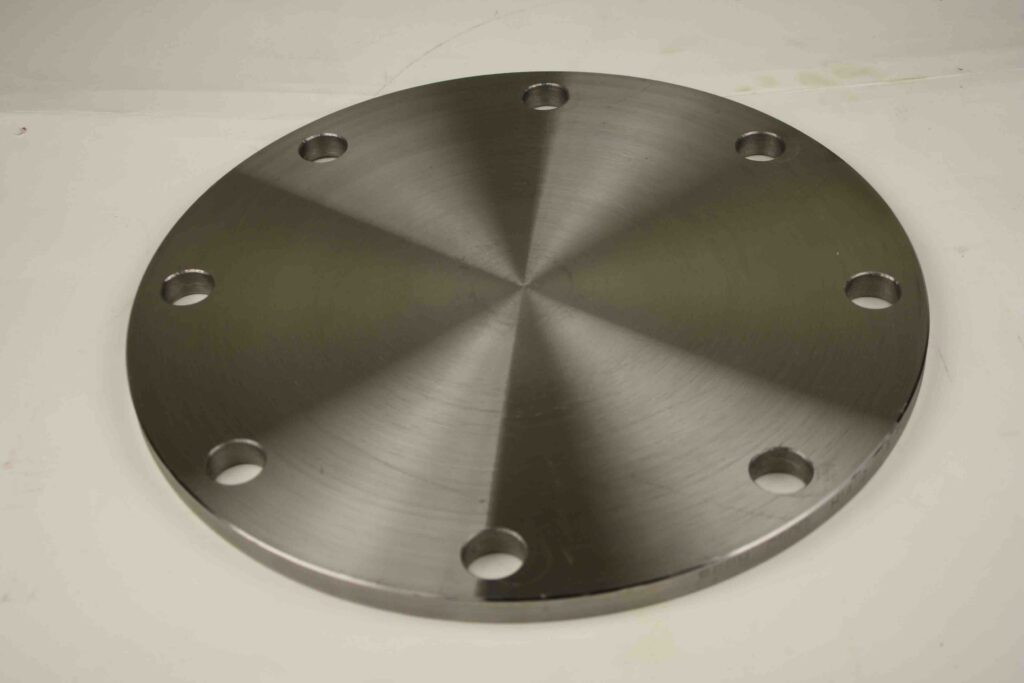
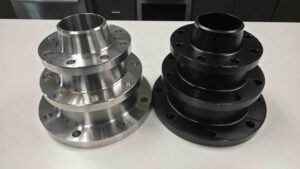
What Determines a Carbon Steel Flange Grade?
Beyond carbon content, grade selection is driven by three additional factors:
- Product form. Forged flanges have denser grain structure and higher consistent strength than plate-cut flanges. ASTM A105 and A694 are forged grades; A36 and A516 are plate grades.
- Service conditions. Operating pressure, temperature range, and the type of media in the line all affect which grade is appropriate.
- Code compliance. ASME B31.3 (process piping) and B31.1 (power piping) standards specify which grades qualify for pressure service.
Types of Common Carbon Steels Used for Flanges
| ASTM Grade | Product Form | Carbon % | Primary Service | Key Standard |
| A36 | Plate / structural | 0.29% max (varies by thickness) | Low-temp, non-pressure, structural | ASTM A36/A36M |
| A105 | Forging | 0.35% max | Ambient to high-temp pressure piping | ASTM A105/A105M |
| A694 | Forging | Varies by grade (F42–F70) | High-pressure oil and gas pipelines | ASTM A694/A694M |
| A516 | Plate | 0.31% max (varies by grade and thickness) | Pressure vessels, moderate temperature | ASTM A516/A516M |
ASTM A36 — Mild Carbon Steel Plate Flanges
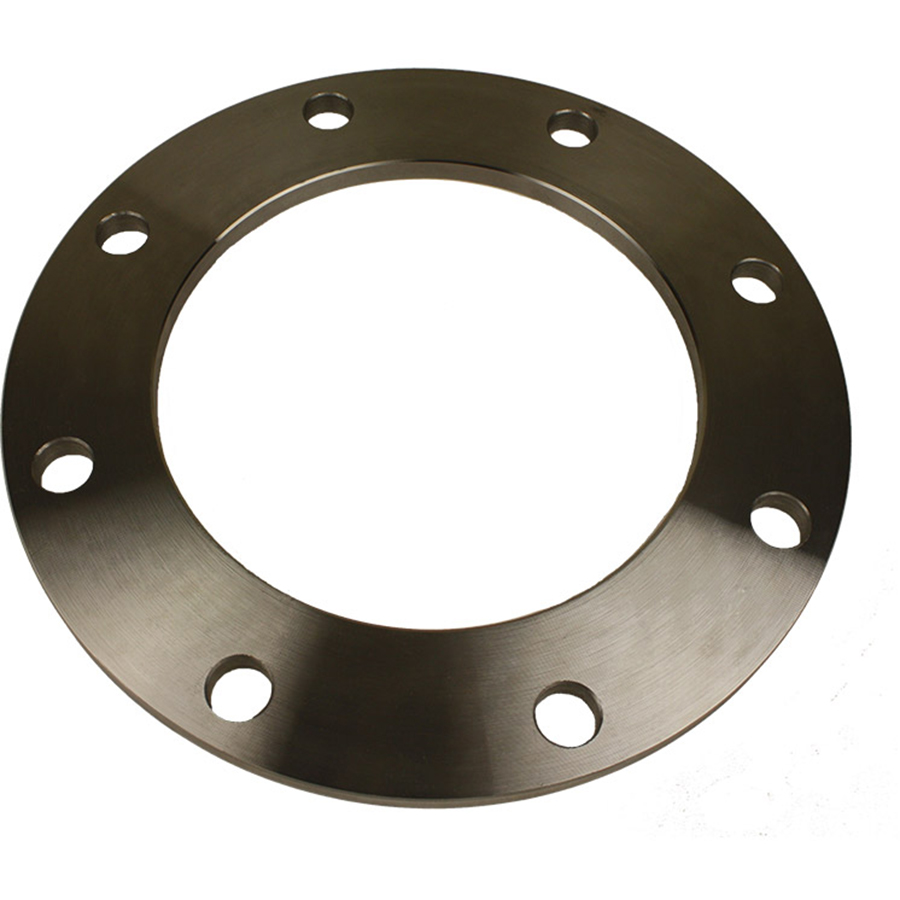
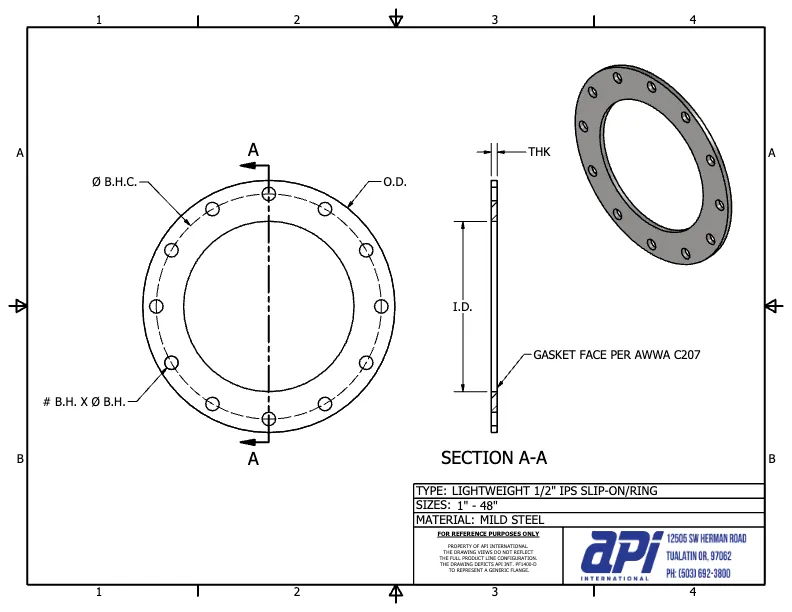
Key mechanical properties of A36 carbon steel:
- Yield strength: 36,000 psi (250 MPa) minimum
- Tensile strength: 58,000–80,000 psi (400–550 MPa)
- Elongation: 20% minimum (in 8 inches)
- Carbon content: ≤ 0.25% (for plates up to ¾ inch thick)
Where A36 Flanges Are Used
Other common applications:
- HVAC and industrial ventilation — large duct connections and air handling equipment
- Structural and agricultural connections — irrigation mainlines, pipe supports, and non-pressure structural pipe frames
What A36 Is Not Suited For
ASTM A105 — Medium Carbon Forged Flanges
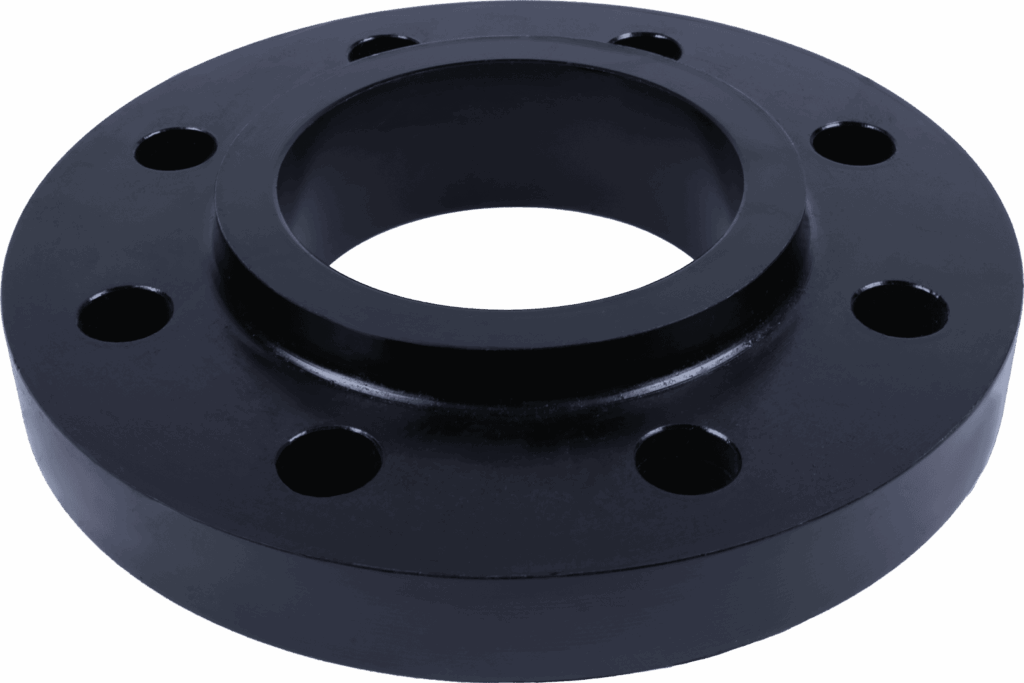
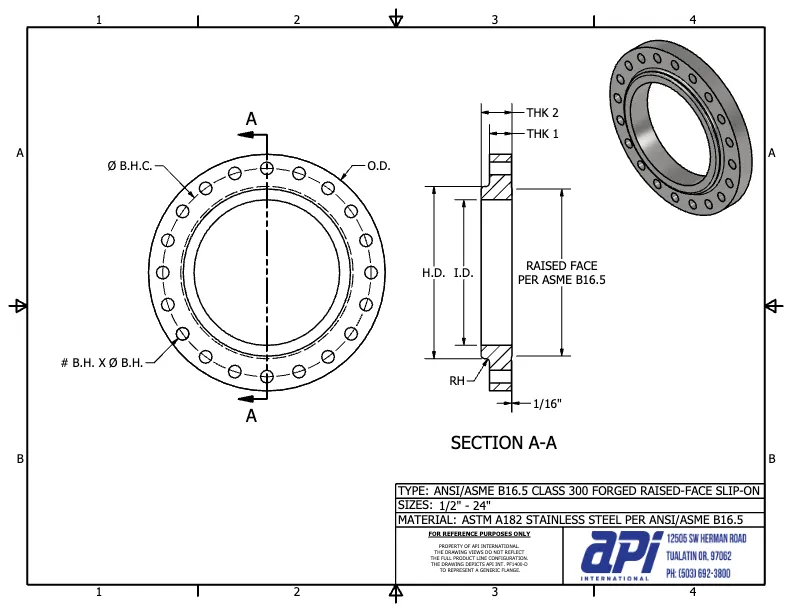
Key mechanical properties of A105 carbon steel:
- Yield strength: 36,000 psi (250 MPa) minimum
- Tensile strength: 70,000 psi (485 MPa) minimum
- Elongation: 22% minimum
- Carbon content: 0.35% maximum
- Service Temperature: Ambient to elevated temperature (≤ 800°F / 425°C)
- Product Form: Forgings
Pressure-Temperature Ratings (Class 150 per ANSI/ASME B16.5, Group 1.1)
| Temperature (°F) | Max Allowable Pressure (psi) |
|---|---|
| -20 to 100 | 285 |
| 200 | 260 |
| 300 | 230 |
| 400 | 200 |
| 500 | 170 |
| 600 | 140 |
| 700 | 110 |
| 800 | 80 |
Pressure Classes and Dimensional Standards
Standard | Size Range | Pressure Classes |
NPS ½” through NPS 24″ | 150, 300, 400, 600, 900, 1500, 2500 | |
ANSI/ASME B16.47 Series A | NPS 26″ through NPS 60″ | 150, 300, 400, 600, 900 |
ANSI/ASME B16.47 Series B | NPS 26″ through NPS 60″ | 75, 150, 300, 400, 600, 900 |
AWWA C207 | NPS 4″ through NPS 144″ | Up to 300 psi working pressure |
Where A105 Flanges Are Used
- Process piping systems governed by ASME B31.3
- Power piping systems governed by ASME B31.1
- Oil and gas surface facilities and refineries
- Chemical processing plants and petrochemical facilities
- Steam lines and elevated-temperature service up to 800°F
- Municipal water infrastructure requiring ASME-rated components
ASTM A694 — High-Pressure Pipeline Flanges
A694 Grade Designations and Mechanical Properties
Grade | Min Yield Strength | Min Tensile Strength | Typical Application |
F42 | 42,000 psi (290 MPa) | 60,000 psi (415 MPa) | Moderate-pressure gas transmission |
F46 | 46,000 psi (315 MPa) | 60,000 psi (415 MPa) | Gas transmission pipelines |
F52 | 52,000 psi (360 MPa) | 66,000 psi (455 MPa) | High-pressure gas and liquid lines |
F56 | 56,000 psi (385 MPa) | 71,000 psi (490 MPa) | High-pressure transmission service |
F60 | 60,000 psi (415 MPa) | 75,000 psi (515 MPa) | High-pressure oil and gas pipelines |
F65 | 65,000 psi (450 MPa) | 77,000 psi (530 MPa) | High-strength pipeline service |
F70 | 70,000 psi (485 MPa) | 82,000 psi (565 MPa) | Highest strength grade in A694 series |
Key Characteristics
- Impact testing. While standard ASTM A694 does not mandate baseline Charpy V-notch testing, it can be ordered with supplementary impact requirements (or per MSS SP-75) to ensure low-temperature notch toughness in cold-weather pipeline networks.
- Higher yield strength. Each A694 grade designation reflects its minimum yield in ksi. F60 and F65 are the most commonly specified grades in modern high-pressure gas pipeline systems.
- Dimensional compliance. A694 flanges are dimensioned per ASME B16.5 and B16.47. They are a material upgrade, not a dimensional change.
- Marking requirements. Flanges must be marked with the ASTM designation, grade (e.g., A694 F60), heat number, and manufacturer identification.
ASTM A516 — Pressure Vessel Plate Flanges
A516 Grade Designations and Mechanical Properties
Grade | Min Yield Strength | Tensile Strength Range | Max Carbon (t .51 to 1.50 in.) | Service |
Grade 55 | 30,000 psi | 55,000 – 75,000 psi | 0.20% | Low-temp pressure vessels |
Grade 60 | 32,000 psi | 60,000 – 80,000 psi | 0.23% | Moderate-temp pressure vessels |
Grade 65 | 35,000 psi | 65,000 – 85,000 psi | 0.26% | General pressure vessels |
Grade 70 | 38,000 psi | 70,000 – 90,000 psi | 0.28% | Most widely used grade |
Key Characteristics
- Low-temperature toughness. A516 is designed for improved notch toughness at low temperatures.
- ASME compliance. A516 is a listed material under ASME BPVC Section VIII, Division 1. It is the standard plate material for fabricated pressure vessels under ASME code.
- Flange applications. A516 flanges are used at pressure vessel nozzle connections and heat exchanger flanges where the vessel shell and flange need matching material.
Grade Comparison: Full Summary
| Criteria | A36 | A105 | A694 | A516 Gr. 70 |
|---|---|---|---|---|
| Product form | Plate | Forging | Forging | Plate |
| Carbon content | 0.29% max (varies by thickness) | 0.35% max | Varies by grade | 0.31% max (varies by thickness) |
| Min yield strength | 36 ksi | 36 ksi | 42–70 ksi | 38 ksi |
| Min tensile strength | 58 ksi | 70 ksi | 60–82 ksi | 70 ksi |
| Max service temp | Low-temp only | 800°F (425°C) | Per design | Moderate-temp |
| Pressure rated | AWWA Only (≤ 300 psi) | Yes | Yes | Yes (ASME VIII) |
| ASME B16.5 listed | No | Yes (Group 1.1) | Yes | No |
| Impact testing req. | No | Optional | Optional/Supplementary requirement | Optional/Supplementary requirement |
| Primary application | Water, HVAC, structural | Process piping | Oil & gas pipelines | Pressure vessels |
How to Select the Right Grade
- Is pressure code compliance required? If the system is governed by ASME B31.3, B31.1, or an equivalent piping code, A105 forged flanges are the minimum requirement. A36 does not qualify.
- What is the operating pressure and temperature? A105 handles up to 800°F and pressure classes through 2500 per ASME B16.5. If yield strength requirements exceed 36 ksi, evaluate A694 grades.
- Is this a pipeline or process system? High-pressure oil and gas transmission pipelines typically require A694. Process piping and facility systems typically require A105.
- Is this a pressure vessel connection? If the flange connects to a pressure vessel, evaluate A516 to match the vessel shell material under ASME Section VIII.
- Is the application non-pressure or waterworks? A36 plate flanges are appropriate for AWWA waterworks service up to 300 psi, HVAC, and structural connections.
- Is low-temperature service a factor? A694 (with impact testing) and A516 are designed for low-temperature toughness. A105 can also be supplied with impact testing when specified.
Conclusion
Related Products
-
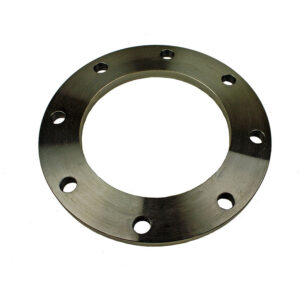
AWWA Class F Steel Ring Flanges
This product has multiple variants. The options may be chosen on the product page -
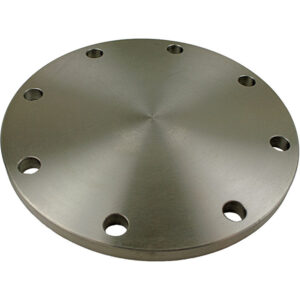
AWWA Class F Steel Blind Flanges
This product has multiple variants. The options may be chosen on the product page -
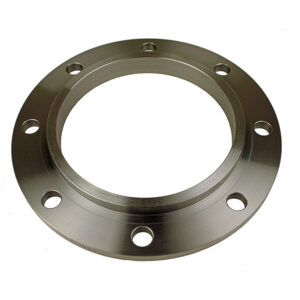
AWWA Class E Steel Hub Ring Flanges
This product has multiple variants. The options may be chosen on the product page -
AWWA Class D Steel Hub Ring Flanges
This product has multiple variants. The options may be chosen on the product page
Frequently Asked Questions
What are carbon steel flanges?
Carbon steel flanges are pipe connection components made from steel with 0.05–2.1% carbon content. They provide strong, durable, and economical joints in industrial piping systems. They are commonly used in power generation, water treatment, chemical processing, construction, and general industrial applications.
What is the difference between carbon steel and stainless steel flanges?
The main difference is corrosion resistance. Stainless steels contain additional elements including chromium, which forms a protective oxide layer that resists rust and chemical attack, making it ideal for corrosive or sanitary environments. Carbon steel, while stronger and more economical, is more prone to rust and usually requires protective coatings for long-term usage.
What grade of steel is used in flanges?
What are carbon steel fittings used for?
Carbon steel flanges and fittings are used to connect, redirect, branch, and terminate piping across a wide range of industrial and utility systems. Common applications include power generation, water and wastewater treatment, HVAC systems, mining, agriculture and irrigation, marine, and lumber and pulp processing.
How to order CS flanges from API International?
To order CS flanges from API International, determine your required pipe size, pressure class, material, and any special standards (such as ANSI/ASME B16.5, or thread style). Contact API International’s experienced team and we will help you select the right flange for your application.