
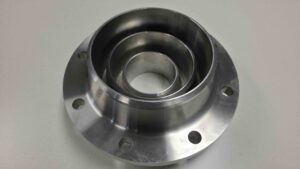
Selecting the right carbon steel flange begins with understanding your application, including its service conditions, required material grade, and appropriate flange type. Getting one of these wrong may not cause an immediate problem, but issues typically surface later, during pressure testing, code review, or inspection. This guide outlines the remaining requirements for a complete order.
Service Conditions
Operating pressure, temperature, and the media running through the line determine material grade, pressure class, and dimensional standard. These variables should be established first, since they rule out entire categories of material and flange type before specific products are compared.
- Pressure. The system’s maximum design/test pressure must fall within a standard ANSI/ASME or AWWA pressure class.
- Temperature. Sustained operating temperature determines whether carbon steel applies, or whether an alloy grade is required.
- Media. Fluid type dictates material selection. While standard carbon steel handles water, steam, and typical hydrocarbons, corrosive or high-hydrogen environments call for alloy or stainless steel.
Applicable Piping Code
The governing piping code determines the material, testing, and documentation standards for a given system, setting the foundation for the entire specification. For example, ASME B31.3 governs process piping, ASME B31.1 governs power piping, and ASME B31.11 (now incorporated into B31.4) applies to slurry transportation piping. Because each standard enforces distinct qualification and inspection criteria, identifying the correct code is essential.
Code | Scope | Typical Systems |
ASME B31.3 | Process piping | Refineries, chemical plants, pharmaceutical and process piping |
ASME B31.1 | Power piping | Power plant steam lines, boiler external piping, district heating |
ASME B31.11 | Slurry transportation piping | Piping transporting aqueous slurries between plants and terminals |
Material Grade
The material grade determines whether a flange is suitable for its intended service at all. ASTM A36 is a structural plate grade suited for fabricated, low- to medium-pressure applications (primarily AWWA waterworks flanges) up to 300 psi, while ASTM A105 is a forged carbon steel grade designed specifically for pressure-rated piping systems governed by ANSI/ASME codes. The two share a similar minimum yield strength but are not interchangeable: substituting A36 where A105 is required is a specification error that surfaces during inspection or code review.
| Property | ASTM A36 | ASTM A105 |
| Product form | Plate / structural shapes | Forgings |
| Max service temperature | Ambient / non-critical | 800°F / 425°C |
| Pressure service | Restricted (AWWA waterworks up to 300 psi) | ASME B31.3 compliant |
| Applicable standards | Structural codes, AWWA C207 | ASME B16.5, B16.47 |
| Typical application | Water systems, HVAC, structural | Process piping, refineries, steam |
For a full comparison of carbon steel grades, see Carbon Steel Flange Grades.
Flange Type and Face Type
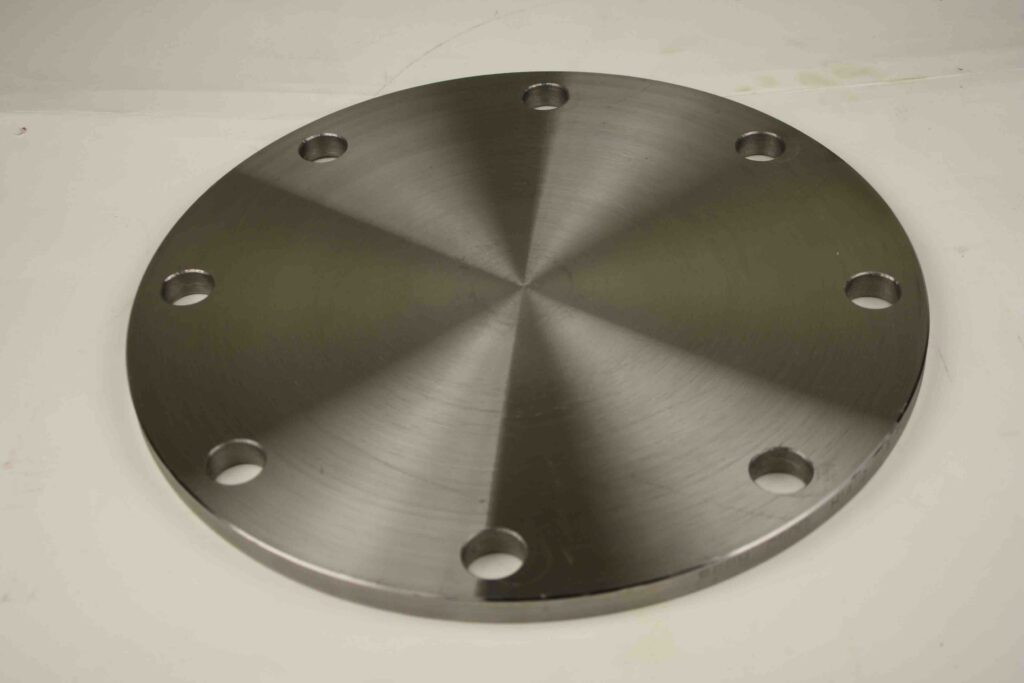
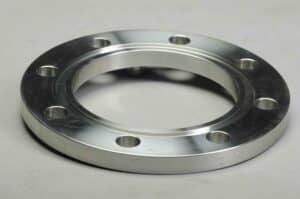
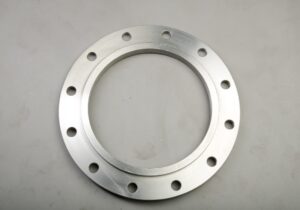
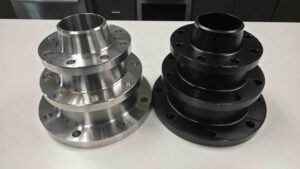
A carbon steel flange’s type and face configuration together determine its fit, seal, and compatibility with mating components. Common flange styles include weld neck, slip-on, blind, socket weld, threaded, and lap joint, each suited to a different combination of pressure, pipe size, and serviceability. Facing options follow a similar logic: raised face (RF) is standard for most process piping, flat face (FF) is specified when mating to cast iron or non-metallic equipment, and ring-type joint (RTJ) is reserved for high-pressure, high-temperature service.
Dimensional Standard
Dimensional standards define a flange’s outside diameter, bolt circle, bore, thickness, and pressure-temperature ratings. Specifying the wrong standard can lead to misapplication or to the flange not aligning with or bolting up to its mating component.
Standard | Size Range | Pressure Basis |
NPS ½” through 24″ | Classes 150 through 2500 | |
NPS 26″ through 60″ (weld neck and blind) | Classes 75 through 900 | |
NPS 4″ through 144″ | Classes B (86psi), D (150-175psi), E (275psi), F (300psi) |
Pressure Class
Pressure class is a reference designation rather than a fixed maximum pressure. Under ANSI/ASME B16.5, pressure classes range from 150 to 2500, where maximum allowable working pressure decreases as operating temperature increases. Determining the correct class requires evaluating design pressure alongside peak operating temperature against the B16.5 pressure-temperature tables. See ANSI/ASME flange pressure ratings for the full breakdown by class.
Certified Mill Test Reports
Certified mill test reports (MTRs) document that the material meets the specified ASTM chemistry and mechanical requirements. On code-governed or quality-critical projects, MTRs are a baseline requirement rather than an optional add-on, and should always be requested at the time of order. Retroactive requests after delivery introduce avoidable delays and may trigger costly re-inspections.
Domestic vs. Imported Material
Federal and state infrastructure projects under Buy American, BABA, and AIS provisions require domestically produced steel. Beyond compliance, domestic A105 and A36 flanges also carry practical advantages: full melt-and-manufacture traceability through certified MTRs, and typically shorter lead times than imported material, since domestic mills and forges stock these grades in volume.
Conclusion
A well-specified carbon steel flange holds up under pressure, passes inspection without surprises, and fits seamlessly into its intended system. API International supplies ASTM A105 and A36 carbon steel flanges, fully machined to meet ANSI/ASME B16.5, ANSI/ASME B16.47, and AWWA C207 dimensional and tolerance specifications. Our sales team specializes in navigating complex flange requirements to ensure your piping system remains fully compliant. Explore the comprehensive range of flanges in our online product catalog, or contact us for custom machining on nonstandard sizes and configurations. Get connected with a dedicated sales representative today, or call us at 503.692.3800.
Related Products
-
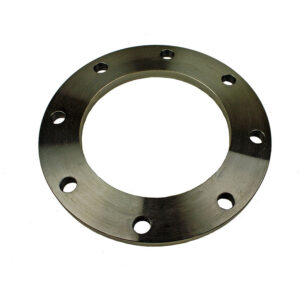
AWWA Class F Steel Ring Flanges
This product has multiple variants. The options may be chosen on the product page -
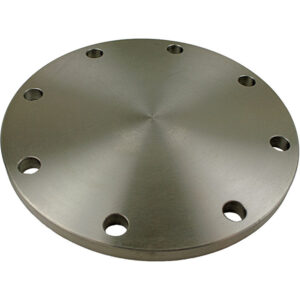
AWWA Class F Steel Blind Flanges
This product has multiple variants. The options may be chosen on the product page -
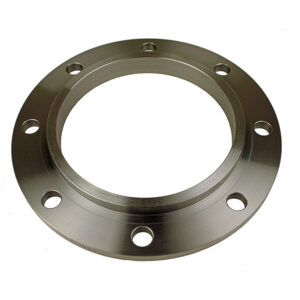
AWWA Class E Steel Hub Ring Flanges
This product has multiple variants. The options may be chosen on the product page -
AWWA Class D Steel Hub Ring Flanges
This product has multiple variants. The options may be chosen on the product page
Frequently Asked Questions
What is the difference between ASTM A36 and ASTM A105 for flange orders?
Why are mill test reports (MTRs) required when ordering flanges?
Certified MTRs confirm that the material's chemistry and mechanical properties match the specified ASTM grade. They are required for code-stamped fabrications and most quality-controlled procurement, and are best requested at time of order rather than after delivery.
Does Buy American apply to carbon steel flanges?
On federal and state infrastructure projects under Buy American and BABA provisions, yes. These projects require domestically produced steel, which domestic A36 and A105 flanges satisfy without the import documentation foreign material requires.
Which piping code governs a carbon steel flange order?
That depends on the system. ASME B31.3 governs process piping, ASME B31.1 governs power piping, and ASME B31.11 (now incorporated into B31.4) governs slurry transportation piping, each with its own material and testing requirements.