

Threaded companion flanges are widely used across industrial, commercial, and municipal piping systems. Selecting the right one for a specific application involves more than just choosing a pipe size. Before specifying or installing a threaded flange, engineers and procurement teams need to understand the governing standards, pressure classes, pressure-temperature ratings, face types, dimensions, and material requirements. This guide covers each of these areas in detail.
Governing Standards
Threaded flanges used in industrial piping are primarily governed by the following standards:
1. ANSI/ASME B16.5 — Pipe Flanges and Flanged Fittings
ANSI/ASME B16.5 is the foundational standard for most threaded flanges in industrial service. This standard covers pipe flanges and flanged fittings from NPS 1/2 through NPS 24. It defines:
- Pressure classes: Class 150, 300, 600, 900, 1500, and 2500. Each of those classes has its own pressure-temperature rating tables organized by material group.
- Facing types: Raised Face (RF), Flat Face (FF), and Ring-Type Joint (RTJ)
- Materials: Acceptable material specifications (ASTM grades)
- Bolting: Stud bolt dimensions, materials, nut specifications, and required engagement.
- Bore dimensions: Threaded bore requirements per pipe size, referencing ASME B1.20.1 for NPT thread form.
2. ANSI/ASME B16.47 — Large Diameter Steel Flanges
ANSI/ASME B16.47 covers flanges in NPS 26 through NPS 60, divided into two series:
- Series A: Heavier flanges originally developed for oil and gas pipeline transmission. They have higher bolt loads and more robust construction.
- Series B: Lighter flanges originally developed for refinery and chemical plant use. They have more compact dimensions compared to series A and lower bolt loads.
Series A and Series B flanges at the same NPS and class are NOT interchangeable! Their bolt patterns and dimensions differ. When specifying large-diameter threaded flanges, the applicable series must be explicitly stated.
3. ASME B1.20.1 — Pipe Threads, General Purpose
ASME B1.20.1 defines the NPT (National Pipe Taper) thread form used in the bore of threaded flanges. This specific thread standard is the defining feature that differentiates them from all other flange types. The bore of threaded flanges is machined with a tapered internal thread rather than a smooth bore for welding.
Thread Sealant and Assembly
B1.20.1 specifies the thread form only, and it does not prescribe sealant type. The applicable piping code (ASME B31.3 for process piping) governs whether PTFE tape, anaerobic thread sealant, or pipe dope is required.
4. MSS SP-44 — Steel Pipeline Flanges
MSS SP-44 is published by the Manufacturers Standardization Society. It covers steel flanges for pipeline service and is the heritage document behind ASME B16.47 Series A. The standard is primarily used in transmission pipeline work, including natural gas, crude oil, and water mains. Flanges in NPS 26 and above are dimensionally heavier than B16.5 equivalents. This reflects the higher bolt loads required for larger diameter, higher pressure pipeline service.
Pressure Classes
ANSI/ASME B16.5 standard also defines pressure classes for threaded flanges. Each class designates a maximum allowable working pressure at a reference temperature — usually 100°F (38°C) for carbon steel — with the allowable pressure decreasing as temperature increases.
| Class | Max. Pressure @ 100°F (Carbon Steel, Group 1.1) | Max. Pressure (bar) | Typical Applications | Common for Threaded Flanges? |
| 150 | 285 psi | 19.6 bar | Low-pressure steam, water, utilities, instrument air | Very Common |
| 300 | 740 psi | 51.1 bar | General process piping, moderate steam, boiler feed | Very Common |
| 600 | 1,480 psi | 102 bar | Moderate-pressure hydrocarbon service, steam mains | Common |
| 900 | 2,220 psi | 153 bar | Higher-pressure process systems, refinery service | Limited — Reduced P-T Rating* |
| 1500 | 3,705 psi | 255 bar | High-pressure hydrocarbon, high-temperature steam | Rarely Used |
| 2500 | 6,170 psi | 425 bar | Very high-pressure critical service | Not Recommended |
Understanding Class vs. Actual Working Pressure
A common field error is reading the class number as a pressure limit. Class 150 does not mean 150 psi — it means 285 psi at 100°F for carbon steel. The actual allowable working pressure depends on three variables that must all be known:
- The pressure class: 150, 300, 600, etc.
- The material group: Determined by the flange material (e.g., A105 = Group 1.1; A182 F316 = Group 2.2).
- The operating temperature: The allowable pressure drops as temperature rises — always read the P-T table at actual operating temperature.
Important: Using Threaded Flanges in Class 900 and Above
ANSI/ASME B16.5 standard notes that threaded flanges in Class 900, 1500, and 2500 have lower pressure-temperature ratings than weld-end flanges of the same class. This is because threads reduce the strength of the pipe wall and are more likely to leak under vibration or temperature changes. In most cases, weld-neck or socket-weld flanges are the better option at these pressure classes. If a threaded flange is required, engineering review is needed before installation.
Pressure-Temperature Ratings
As we noted before, pressure ratings are not fixed values — they are temperature-dependent. As temperature rises, the allowable pressure decreases due to the reduction in yield strength of the material. ANSI/ASME B16.5 standard provides complete pressure-temperature rating tables for each material group and class combination. Engineers must always identify the correct material group and read the P-T table at actual operating temperature.
Example: Class 150, ASTM A105 Carbon Steel (Material Group 1.1)
Temperature (°F) | Temperature (°C) | Max. Pressure (psi) | Max. Pressure (bar) | % Retained vs. Max. |
-20 to 100 | -29 to 38 | 740 | 51.1 | 100% |
200 | 93 | 680 | 46.9 | 92% |
400 | 204 | 655 | 45.2 | 88% |
600 | 316 | 600 | 41.4 | 81% |
800 | 427 | 550 | 37.9 | 74% |
1000 | 538 | 535 | 36.9 | 72% |
Example: Class 300, ASTM A105 Carbon Steel (Material Group 1.1)
Temperature (°F) | Temperature (°C) | Max. Pressure (psi) | Max. Pressure (bar) | % Retained vs. Max. |
-20 to 100 | -29 to 38 | 285 | 19.6 | 100% |
200 | 93 | 260 | 17.9 | 91% |
400 | 204 | 230 | 15.9 | 81% |
600 | 316 | 200 | 13.8 | 70% |
800 | 427 | 170 | 11.7 | 60% |
1000 | 538 | 140 | 9.7 | 49% |
Flange Face Types
The face of a flange is the sealing surface where the gasket sits. For threaded companion flanges, the face type must be compatible between both mating flanges and the gasket material selected. ANSI/ASME B16.5 defines three primary face types for flanges used in industrial piping:
1. Raised Face (RF)
The Raised Face is the most common face type in industrial process piping. A raised circular area on the flange face concentrates gasket compression onto a smaller seating area, increasing contact stress and improving sealing efficiency.
When to Use Raised Face
RF is the default specification for steel-to-steel flange connections in process piping, oil and gas, power, and general industrial applications. If your specification does not state otherwise, and you are connecting two steel flanges, RF is almost certainly correct.
2. Flat Face (FF)
The seating surface of a Flat Face flange is flush with the flange OD — there is no raised area. This face type is required when mating to flat-face flanges on cast iron, ductile iron, or non-ferrous equipment such as cast iron valves, pumps, or other brittle components.
Key requirements for Flat Face flanges:
- Full-face gasket required: A gasket covering the entire flange face (including the area outside the bolt circle) must be used. This distributes bolt load evenly across the entire face and prevents the cracking or bending that a concentrated load would cause on brittle equipment.
- AWWA C207 default: All AWWA C207 steel flanges for waterworks service are specified as Flat Face. This is standard for municipal water and wastewater piping.
- Cannot use spiral-wound gaskets: Full-face gaskets are typically sheet gaskets (compressed fiber, PTFE, rubber). Spiral-wound gaskets are designed for raised-face applications only.
* Critical Warning: never mate RF to FF without engineering review and always confirm face type compatibility before assembly.
3. Ring-Type Joint (RTJ)
The Ring-Type Joint face has a precision-machined groove cut into the face that accepts a solid metallic ring gasket. When the bolts are tightened, the ring deforms slightly to fill micro-surface irregularities in the groove, creating an extremely reliable seal.
Dimensions and Nominal Pipe Sizes (NPS)
Threaded flange dimensions — including outside diameter (OD), bolt circle diameter (BCD), bolt hole diameter, flange thickness, bore size, and raised face diameter — are standardized in ANSI/ASME B16.5 for sizes NPS 1/2 through NPS 24.
Basic Dimensions for Threaded Flanges
The following table shows dimensional ranges for ASME B16.5 threaded flanges from ½″ to 24″ nominal pipe size (NPS).
| NPS Range | Outside Diameter (OD) | Bore Diameter (A) | Flange Thickness (B) |
|---|---|---|---|
| ½″ – 2″ | 3.5″ – 6.0″ | 0.62″ – 2.07″ | 0.44″ – 0.82″ |
| 2½″ – 6″ | 7.0″ – 11.0″ | 2.47″ – 6.07″ | 0.88″ – 1.19″ |
| 8″ – 12″ | 13.5″ – 19.0″ | 8.07″ – 12.11″ | 1.31″ – 1.44″ |
| 14″ – 20″ | 21.0″ – 27.5″ | 14.13″ – 20.15″ | 1.62″ – 2.00″ |
| 24″ | 32.0″ | 24.15″ | 2.25″ |
Materials and Material Groups
The material of a threaded flange must be compatible with the fluid service, operating temperature range, and corrosion environment. ANSI/ASME B16.5 organizes flange materials into material groups which determine the applicable pressure-temperature ratings.
1. Carbon Steel — ASTM A105
ASTM A105 is the most widely used material for threaded flanges in general industrial, oil and gas, and waterworks service. It is a carbon steel forging specification covering flanges, fittings, and valves. Key properties:
- Temperature range: -20°F to 800°F (-29°C to 427°C) per ASME B16.5 Group 1.1 P-T tables.
- Minimum tensile strength: 70,000 psi per ASTM A105.
- Corrosion resistance: Limited — carbon steel is susceptible to general corrosion in wet, acidic, or chloride-containing environments. Protective coatings or cathodic protection are typically required in corrosive service.
2. Stainless Steel — ASTM A182 F304 and F316
ASTM A182 covers forged and rolled alloy and stainless steel flanges. F304 and F316 are the two most common stainless steel grades for threaded flanges in corrosive or hygienic service.
3. Chrome-Moly Alloy — ASTM A182 F11 and F22
| Grade | Composition | Key Characteristic | Limitation |
|---|---|---|---|
| F304 | 18% Cr, 8% Ni | Excellent general corrosion resistance. FDA-acceptable for food and pharmaceutical applications. | Susceptible to chloride stress corrosion cracking (SCC) above approximately 140°F in high-chloride environments |
| F316 | 18% Cr, 10% Ni, 2-3% Mo | Molybdenum improves resistance to pitting and crevice corrosion. Preferred for marine, offshore, and coastal applications. | Still susceptible to SCC under combined high chloride concentration and elevated temperature |
| F304L / F316L | Low-carbon variants | Resists sensitization in heat-affected zones. Recommended when welding near threaded flanges is involved. | Lower strength compared to standard grades |
| F304/304L & F316/316L | Low-carbon variants | Meets the low-carbon requirement of 304L/316L and high-strength requirements of 304/316. | Higher cost vs. standard grades; still susceptible to SCC in high-chloride, high-temperature environments. |
Chrome-molybdenum alloy steels are specified where both elevated temperature strength and oxidation resistance are required. Primarily used in power generation, refinery, and high-temperature steam service.
| Grade | Composition | Typical Service | Key Characteristic |
|---|---|---|---|
| F11 | 1.25% Cr, 0.5% Mo | Power generation, high-temperature steam | Suitable up to approximately 1100°F. Better creep resistance than carbon steel at elevated temperature |
| F22 | 2.25% Cr, 1% Mo | Boiler feed, hot reheat, refinery reactor piping | Higher alloy content for higher temperature service |
4. Duplex Stainless Steel — ASTM A182 F51
Duplex stainless steel F51 combines austenite and ferrite, giving it roughly twice the yield strength of standard stainless grades. It is commonly specified for threaded flanges in aggressive environments where standard stainless steel is not sufficient.
- Composition: 22% Cr, 5% Ni, 3% Mo
- Yield Strength: Approximately twice that of F304 or F316
- Max. Temperature: 575°F (300°C) per ASME B16.5 P-T tables
- Corrosion Resistance: Excellent resistance to chloride stress corrosion cracking
- Typical Applications: Offshore platforms, subsea piping, and desalination
Conclusion
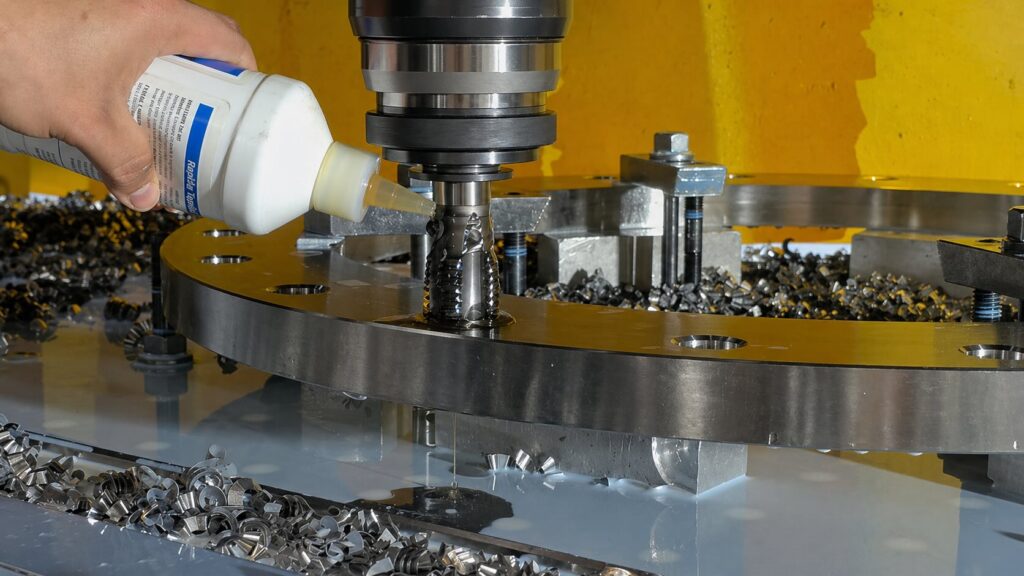
Getting the specification right for a threaded flange involves more than one decision. The governing standard, pressure class, pressure-temperature rating, face type, dimensions, and material must work together for the joint to perform correctly. Always verify your final selection against the current edition of the applicable standard before specifying or installing. Our sales team at API International specializes in navigating complex flange requirements to ensure your system meets its design specifications. Our in-house machine shop can modify any stock flange to add threads to the inner diameter (ID) or bolt holes (BH).
Explore our comprehensive range of flanges in our online product catalog, or contact us for custom options tailored to your unique project needs. Get connected with a dedicated sales representative today, or call us at 503.692.3800.