Why the Safe Drinking Water Act Requires Lead-Free Flanges

“Lead-free” is not a marketing phrase on a flange spec sheet. This is a specific limit set by federal law. Any flange which is used in a drinking water system has to meet this requirement. And that is why certified flanges carry an NSF/ANSI/CAN 372 mark. In this article, we explain where the rule comes from, what the term “lead-free” actually means, and how it applies to flanges.

The Rule Behind the Requirement

In September 2020, the EPA issued its Final Rule, “Use of Lead Free Pipes, Fittings, Fixtures, Solder, and Flux for Drinking Water.” That rule codifies the Reduction of Lead in Drinking Water Act of 2011 (RLDWA) and The Community Fire Safety Act of 2013 (CFSA). Together, they prohibit introducing into commerce any pipe, plumbing fitting, or fixture that is not lead free. An exception applies when the specific use is for manufacturing or industrial purposes.

What "Lead-Free" Actually Means

Component TypeWeighted Average Lead Content Limit
Pipes, pipe fittings, plumbing fittings, and fixtures0.25%
Solder and flux0.2%
The Act’s definition of “lead free” means a weighted average of no more than 0.25% lead across the wetted surfaces of pipes, pipe fittings, plumbing fittings, and fixtures. For solder and flux, the limit is 0.2%. The calculation is consistent with NSF/ANSI/CAN 372. Two products built from nominally similar alloys can fall on opposite sides of the threshold. The result depends on how much wetted surface area each individual component contributes to the overall assembly.
It’s important to notice that the rule requires certification by an accredited third party certification body. A manufacturer stating that its own product is lead free, without any outside verification, does not satisfy the Act’s requirement. The calculation has to be independently tested and confirmed.

Which Products Are Required to Be Lead-Free

The requirement applies broadly across potable water infrastructure:
  • Pipe, fittings, and fixtures used in potable water systems
  • Drinking water coolers, fountains, and bottled water fillers
  • Plumbed-in point-of-use treatment devices and coffeemakers
  • Refrigerator ice and water dispensers, water heaters, meters, pumps, and tanks
  • Commercial food equipment using potable water — beverage dispensers, commercial ice makers

Which Products Are Exempt

The Act carves out specific exemptions, and a few of them sit close to the waterworks and large-diameter flange space specifically:
  • Products used exclusively for non-potable service, including: manufacturing, industrial processing, irrigation, outdoor watering
  • Products clearly labeled “not for use with water for human consumption” or an equivalent phrase
  • Toilets, bidets, urinals, fill valves, flushometer valves, tub fillers, and shower valves
  • Fire hydrants, service saddles, and water distribution main gate valves 2 inches or larger in diameter
  • Clothes washing machines, emergency drench showers and eyewash equipment, fire suppression sprinklers, steam-capable clothes dryers, and sump pumps
That gate valve and fire hydrant exception is worth noting for large diameter waterworks buyers. Certain large distribution components are excluded from the lead free requirement. The flanges connecting most of a potable water system, however, remain subject to it.

Which Marks Indicate Compliance

The Act recognizes a few specific certification marks as evidence of compliance. Products may be listed directly to NSF/ANSI/CAN 372. They may also be listed to NSF/ANSI/CAN 61, which requires evaluation to NSF/ANSI/CAN 372 with limited exemptions. Products listed to NSF/ANSI 14 for potable water also require NSF/ANSI/CAN 61 evaluation and evaluation to NSF/ANSI/CAN 372. For commercial food equipment, the NSF listing typically states the product’s weighted average lead content. It also confirms compliance with applicable state laws in California, Vermont, Maryland, and Louisiana. These laws predate and align with the federal requirement under the Safe Drinking Water Act.
NSF-ANSI-CAN_61-G_372

How This Applies to Flanges

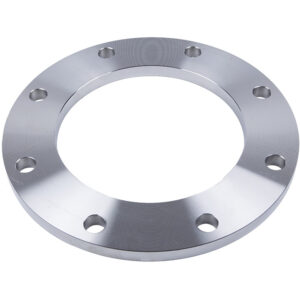
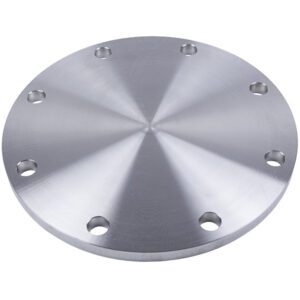
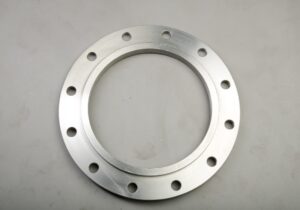
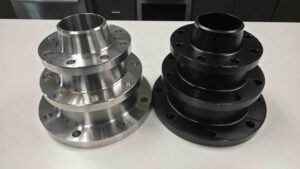
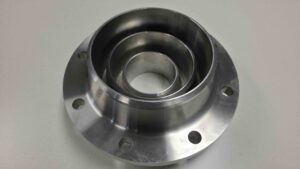
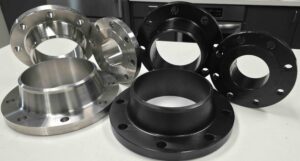
Flanges which are used in drinking water systems automatically fall under the lead-free requirement. A flange is a pipe fitting, and pipe fittings in potable water service have to meet the 0.25% weighted-average limit. The exemptions for fire hydrants and large distribution gate valves do not change that. The flanges that connect pumps, valves, meters, and piping across a potable water system still have to comply.
For a stainless steel flange, the base metal is rarely the concern. Grades like 304/304L and 316/316L carry very little lead on their own. But the weighted-average calculation still looks at the full assembly. If a flanged connection includes a leaded component somewhere in the wetted path, such as a brass fitting, that component factors into the result. This is why the lead free requirement is verified at the assembly level. It is confirmed through NSF 372 certification and not assumed from the flange material alone.

Conclusion

The 0.25% lead free threshold is a federal requirement verified through independent third party testing, not a voluntary industry benchmark. API International’s CleanLine are manufactured with domestically sourced 304/304L & 316/316L stainless steel to meet AIS/BABA requirements. This product line is evaluated and certified to both NSF-61 and NSF-372 standards. See our official certification listing page for a list of our NSF-61-372 certified products. For a buyer specifying flanges for municipal water systems, a treatment plants, or any potable or clean water application, that means the certification on the spec sheet reflects the full picture: health effects and lead content are both verified by an independent third party, not a manufacturer’s own claim.

Related Products

Frequently Asked Questions

What law actually requires flanges to be lead-free?

The federal Safe Drinking Water Act, specifically as codified by the EPA's September 2020 Final Rule, which built on the Reduction of Lead in Drinking Water Act of 2011 and the Community Fire Safety Act of 2013.

What does "lead-free" legally mean under the Act?

A weighted average of 0.25% lead calculated across the wetted surfaces of a pipe, pipe fitting, plumbing fitting, or fixture, and 0.2% for solder and flux.

Can a manufacturer just declare its own flanges lead-free?

No. The rule mandates third-party certification by an accredited certification body — a manufacturer's self-declared compliance statement isn't sufficient under the Act.

Are any flange-adjacent products exempt from the lead-free requirement?

Yes. Fire hydrants, service saddles, and water distribution main gate valves 2 inches or larger in diameter are specifically exempted, along with products used exclusively for non-potable service.

Which NSF marks show compliance with the Act?

Products listed to NSF/ANSI/CAN 372, products listed to NSF/ANSI/CAN 61 (which requires NSF-372 evaluation with limited exemptions), and products listed to NSF/ANSI 14 for potable water.

Video Guide to NSF-Certified Flanges