

The Reasons to Choose Weld Neck Flanges

A weld neck flange typically costs more and takes longer to install than a slip-on or threaded flange. But it is still the standard choice for high-pressure and critical piping systems. In this guide, we cover the design features behind that choice, the pressure ratings of weld neck flanges, and data that support their use.

Key Advantages of Weld Neck Flanges

1. How the Tapered Hub Distributes Stress

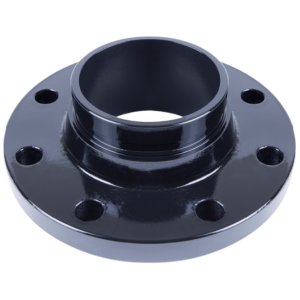
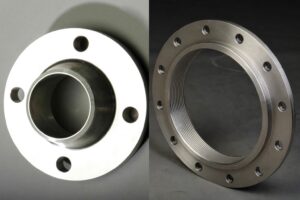
One of the defining features of weld neck flanges is their tapered hub. The hub reduces the flange thickness gradually down to the pipe wall thickness. This helps spread stress over a longer section of material instead of concentrating it at one point. It matters for any joint under sustained pressure or repeated loading. Flange types with a short hub or no hub at all make that transition over a much shorter distance.
The hub is long compared with the flange itself. In the Class 150 weld neck dimension tables, the length through the hub runs about three to five times the flange thickness, depending on size.
NPS Flange thickness (in.) Length through hub, Y (in.) Hub length ÷ thickness
2 0.69 2.44 3.5
4 0.88 2.94 3.3
8 1.06 3.94 3.7
12 1.19 4.44 3.7
24 1.81 5.94 3.3
Class 150 weld neck dimensions per ANSI/ASME B16.5, from API International’s weld neck flange dimension tables. The ratio is calculated from the listed values.

2. Full-Penetration Weld Strength

A weld neck flange connects to pipe with a single full-penetration butt weld. In contrast, slip-on flanges use fillet welds instead, and threaded flanges use threads. The benefit of a full-penetration weld is that it carries load through the full thickness of the joint. That gives it higher fatigue resistance under cyclic pressure, vibration, and thermal expansion than a fillet-welded or threaded connection.
A butt weld can also be examined with radiographic or ultrasonic testing when the piping code or project specification requires it. Our weld neck flange welding procedure guide covers bevel preparation, qualification, and inspection.

3. Smooth Bore and Flow Performance

The bore of a weld neck flange matches the inside diameter of the pipe. This limits flow restriction at the joint, which reduces turbulence and erosion. The long taper also gives a smooth change in wall thickness. That helps in lines where expansion and other forces cause repeated bending.

4. Forged Construction

Weld neck flanges are forged, not cast or cut from plate. Forging, most produces a continuous grain flow that follows the contour of the hub and flange face. That grain structure runs through the area where stress concentrates once the flange is welded and in service. Our guide to how weld neck flanges are made explains the forging sequence and why it matters.

5. Pressure Class and Size Coverage

Weld neck flanges are available in every ANSI/ASME B16.5 pressure class, 150 through 2500. B16.5 covers NPS ½″ through 24″ in Classes 150 through 1500, and Class 2500 in NPS ½″ through 12″. For larger sizes, ANSI/ASME B16.47 covers weld neck and blind flanges from NPS 26″ through 60″ in Classes 75 through 900. In larger sizes and higher pressure classes, weld neck flanges are usually the only type specified.
A class number is a rating, not a pressure limit. The allowable pressure depends on the material and the temperature. A Class 150 A105 flange is rated 285 psig at 100°F but only 80 psig at 800°F. The table below gives reference values for ASTM A105 carbon steel.
Class At 100°F (psig) At 400°F (psig) At 800°F (psig)
150 285 200 80
300 740 635 410
400 985 845 550
600 1,480 1,265 825
900 2,220 1,900 1,235
1500 3,705 3,170 2,055
2500 6,170 5,280 3,430
Reference values for ASTM A105 (ANSI/ASME B16.5, Group 1.1), ANSI/ASME Flange Pressure Ratings. The rating for the actual material and temperature should be confirmed in ANSI/ASME B16.5.

6. Temperature and Material Options

Weld neck flanges are forged in carbon, stainless, and alloy steels, so the material can be matched to the temperature and the fluid. ASTM A105 carbon steel covers ambient to moderately elevated temperatures, up to roughly 800°F (425°C). ASTM A182 covers alloy grades for higher-temperature steam and process lines, and stainless grades where corrosion resistance decides the choice.

Grade

Product Form

Typical Service

ASTM A105

Forged carbon steel

General process and power piping, ambient to 800°F

ASTM A182 F304/F304L

Forged stainless steel

Corrosion resistance, moderate-temperature process piping

ASTM A182 F316/F316L

Forged stainless steel

Higher corrosion resistance, chloride and marine environments

ASTM A182 F11, F22, F91

Forged alloy steel

High-temperature steam and process piping above carbon steel limits

Forged stainless weld neck flanges are also available certified to NSF-61/372 for drinking water systems through CleanLine. Our guide to weld neck flange materials and standards covers grade selection in more detail.

7. Performance in Cyclic and Vibration-Heavy Service

Steam lines, boiler connections, and other thermal systems put piping joints through repeated expansion and contraction. Offshore platforms add constant vibration. Under those conditions, a threaded connection can loosen over time, because repeated movement fatigues the thread sealant layer and reduces thread engagement. A full-penetration weld has no thread to loosen, and the tapered hub reduces stress concentration at the base. A slip-on flange carries load through fillet welds at a sharper transition, so its fatigue resistance under cyclic loading is lower by comparison.

8. Code Requirements and Inspection

Piping codes also affect flange selection. The process piping code ASME B31.3 places service-based restrictions on where slip-on flanges can be used. Weld neck flanges are a common alternative in those services. Their welds follow a qualified procedure under ASME Section IX, and the extent of weld examination is set by the piping code and the project specification.

Weld Neck vs. Slip-On and Threaded Flanges

The table below shows the main differences side by side. Visit our guides to slip-on vs. weld neck flanges and choosing between weld neck and threaded flanges.

Property

Weld Neck Flange

Slip-On Flange

Threaded Flange

Connection to pipe

Single full-penetration butt weld

Slips over the pipe; inner and outer fillet welds

Screws onto threaded pipe; no welding

Bore

Matches the pipe inside diameter

Slightly larger than the pipe outside diameter

Tapered internal NPT thread

Standards and classes

B16.5 Classes 150–2500; B16.47 Classes 75–900

B16.5 only; not covered by B16.47

B16.5; most common in Class 150, 300, and 600

Sizes

NPS ½″ through 60″ (B16.5 to 24″, B16.47 for 26″–60″)

Up to NPS 24″ under B16.5

Typically smaller diameters

Fatigue resistance under cyclic loading

Higher

Lower by comparison

Not recommended where cycling or vibration is present

Installation

Qualified welding procedure, precise bevel alignment, weld inspection

Easier alignment; two fillet welds

No welding equipment or procedure

Typical use

High-pressure, high-temperature, critical, and cyclic service

General service, lower pressure, water and utility lines

Low-pressure utility lines, small-bore piping, hot-work-restricted areas

Where These Advantages Matter Most

The advantages matter most in high-pressure pipelines, steam and thermal systems, offshore and subsea platforms, large-diameter water mains, and chemical and process plants. In these systems, a failed joint is costly, and service conditions work against a weaker connection over time. Our guide to weld neck flange types and applications covers each use in more detail.

Conclusion

A weld neck flange earns its place through three features. A tapered hub spreads stress, a full-penetration weld resists fatigue, and the design covers every ANSI/ASME pressure class and sizes up to NPS 60. API International weld neck flanges are fully machined from A105 forged carbon steel and A182 and 304/316 forged stainless steel and meet ANSI/ASME B16.5 and ANSI/ASME B16.47 standards. Explore the comprehensive range of flanges in our online product catalog, or contact us for custom machining on nonstandard sizes and configurations. Get connected with a dedicated sales representative today, or call us at 503.692.3800.

Frequently Asked Questions

What are the advantages of weld neck flanges?

Weld neck flanges reduce stress concentration at the joint through a tapered hub, handle high pressure and temperature, and form a seamless, leak-resistant connection through a full-penetration butt weld. They are available in every ANSI/ASME B16.5 pressure class and, for NPS 26″ through 60″, in ANSI/ASME B16.47.

Why are weld neck flanges used in high-pressure piping?

The tapered hub spreads stress over a longer section of material, and the full-penetration butt weld carries load through the full thickness of the joint. Together they give higher fatigue resistance under pressure spikes and cyclic loading than fillet-welded or threaded connections. In larger sizes and higher pressure classes, weld neck flanges are usually the only type specified.

What pressure classes and sizes do weld neck flanges come in?

ANSI/ASME B16.5 covers NPS ½″ through 24″ in Classes 150 through 1500, and Class 2500 in NPS ½″ through 12″. ANSI/ASME B16.47 covers weld neck and blind flanges from NPS 26″ through 60″ in Classes 75 through 900.

Do weld neck flanges perform better under vibration and thermal cycling?

Yes. A full-penetration weld has no thread or sealant layer to loosen, and the tapered hub reduces stress concentration at the base. Threaded connections can loosen under repeated vibration or thermal cycling, which is why they are not recommended for those services.

Are weld neck flanges worth the higher cost?

For high-pressure, high-temperature, or cyclic service, yes. Weld neck flanges cost more to make and take longer to install, so for low-pressure, general-service lines a slip-on or threaded flange is often enough.

What is the difference between a slip-on and a weld neck flange?

A slip-on flange slips over the pipe and is joined with both an inner and an outer fillet weld. Most forged slip-ons have a low hub, and plate slip-on flanges have no hub. A weld neck flange has a long, tapered hub and is joined with a single full-penetration butt weld, which gives it higher fatigue resistance under cyclic loading.

Is a weld neck flange required for every piping system?

No. Low-pressure, general-service, or non-critical lines often perform well with simpler and less expensive flange types. Weld neck flanges are worth specifying where pressure, temperature, or cyclic conditions make joint reliability the priority. Our guide to choosing between weld neck and threaded flanges explains how to decide.

Related Products

Video Guide to Weld Neck Flanges