

Weld Neck Flange Types
Standard Weld Neck
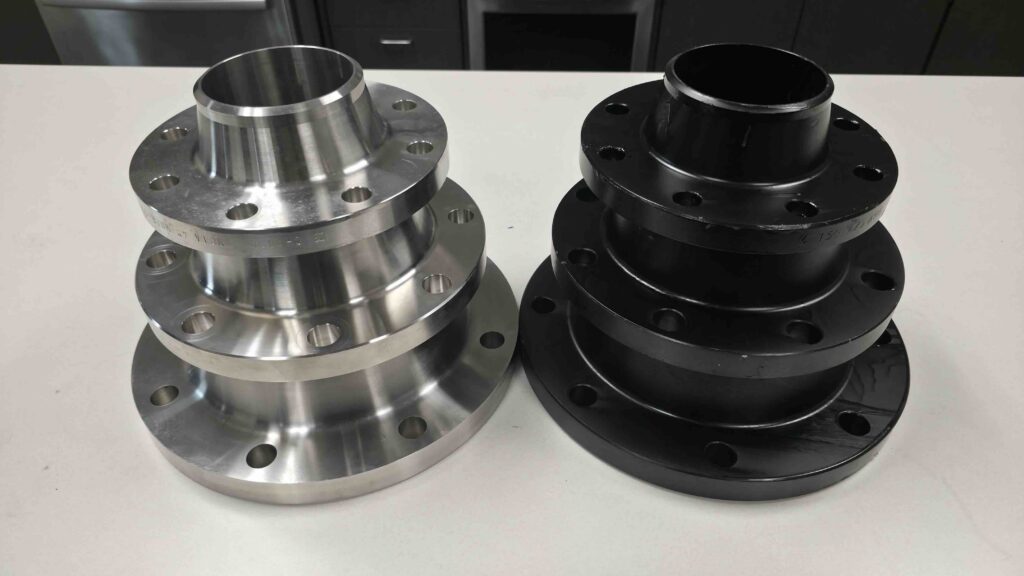
This is the most common type, with a tapered hub of moderate length that butt-welds directly to the matching pipe. This type is available across the full range of ANSI/ASME B16.5 and B16.47 pressure classes and sizes.
- Manufactured in forged ASTM A105 carbon steel or ASTM A182 stainless steel.
- Rated across the full range of ANSI/ASME B16.5 pressure classes, 150 through 2500.
- The tapered hub transitions gradually into the pipe wall thickness, distributing stress along the joint.
- This is the main choice for general inline process and pipeline connections.
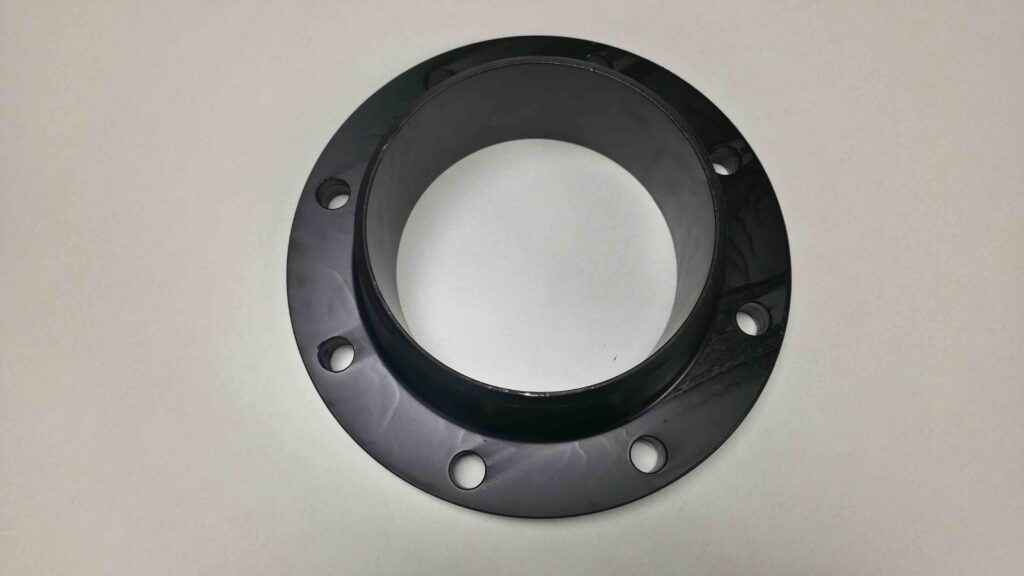
Long Weld Neck
A long weld neck flange has an extended hub longer than the standard configuration and is often used as a nozzle on pressure vessels rather than an inline pipe connection. The extra hub length provides additional reinforcement where the flange penetrates the vessel wall.
- Hub length is typically specified to match the vessel wall thickness plus the projection needed for internal components.
- Common in pressure vessel, heat exchanger, and boiler nozzle connections.
- Often referred to as a “nozzle flange” on vessel fabrication drawings.
- This type reduces the number of separate weld joints needed at a vessel penetration.
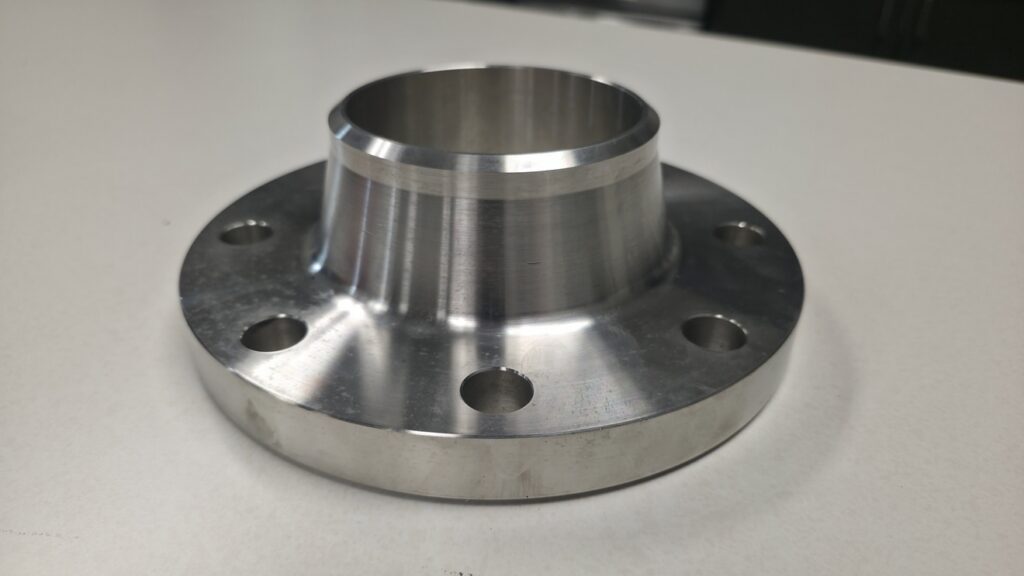
Reducing Weld Neck
A reducing weld neck flange has a hub with a reducing bore. This type of flange allows a larger flange to connect directly to a smaller-diameter pipe without a separate reducer fitting. This is common where a line changes size at a valve, pump, or equipment connection.
- A reducing weld neck flange combines the flange and reducer into a single forged component, eliminating one weld joint from the system.
- This type is commonly specified where a line steps down in size at a pump, valve, or piece of equipment.
- Reduces total part count and installation time compared to a separate reducer plus standard flange.
- Available in the same pressure classes as standard weld neck flanges.

Raised-Face Weld Neck
Raised face weld neck flanges have a small raised sealing area right above the bolt circle, which improves gasket compression. This is the standard facing for high-pressure, high-temperature systems and the most commonly specified face type for weld neck flanges in process piping.
- Raised face height is typically 1/16 inch (1.6 mm) above the bolt circle face for Class 150 and Class 300, and 1/4 inch (6.4mm) for Class 400 and higher per ANSI/ASME B16.5.
- This type is compatible with standard ring-type gaskets, including spiral-wound and flat ring gaskets.
- Available across all ANSI/ASME B16.5 pressure classes.
- This is the default face type unless a project specification calls for flat face or ring-type joint.
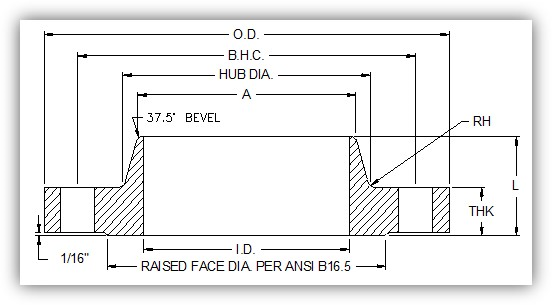
Flat-Face Weld Neck
Flat face (FF) weld neck flanges have a flush sealing surface with no raised area. Because forcing a raised face flange against brittle material can cause severe cracking under bolt load, the flat face design is used in lower-pressure lines or when mating directly to cast iron, bronze, or fiberglass equipment.
- The sealing surface of this flange type sits flush with the bolt circle face, with no raised area.
- Typically paired with a full-face gasket rather than a ring gasket.
- FF weld necks are usually specified per ANSI/ASME B16.5 when mating to cast iron, fiberglass, or other equipment that cannot handle the concentrated bolt load of a raised face.
- They are common in low-pressure water, wastewater, and utility piping systems.
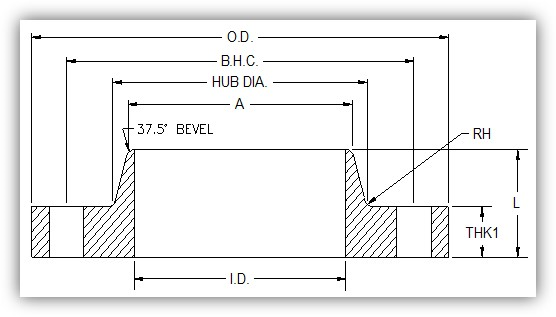
Applications of Weld Neck Flanges
Chemical and Process Piping
Steam and Thermal Systems
Offshore and Subsea Platforms
Large-Diameter Water Mains
Conclusion
Frequently Asked Questions
What is the difference between a standard and a long weld neck flange?
What is a reducing weld neck flange used for?
When is a flat-face weld neck flange used instead of raised-face?
Which industries rely most on weld neck flanges?
Why are weld neck flanges preferred for high-pressure pipelines?
Related Products
-
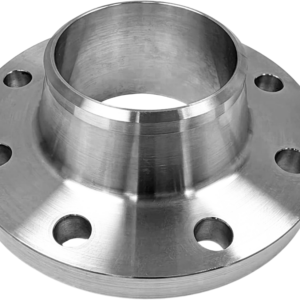
ANSI/ASME B16.5 Class 150 Forged Stainless Steel Raised Face Weld-Neck Flanges (NSF-61-372)
This product has multiple variants. The options may be chosen on the product page -
ANSI/ASME B16.47 Series B Class 150 Forged Stainless Steel Raised Face Weld-Neck Flanges (NSF-61-372)
This product has multiple variants. The options may be chosen on the product page -
ANSI/ASME B16.47 Series A Class 150 Forged Stainless Steel Raised Face Weld-Neck Flanges (NSF-61-372)
This product has multiple variants. The options may be chosen on the product page